
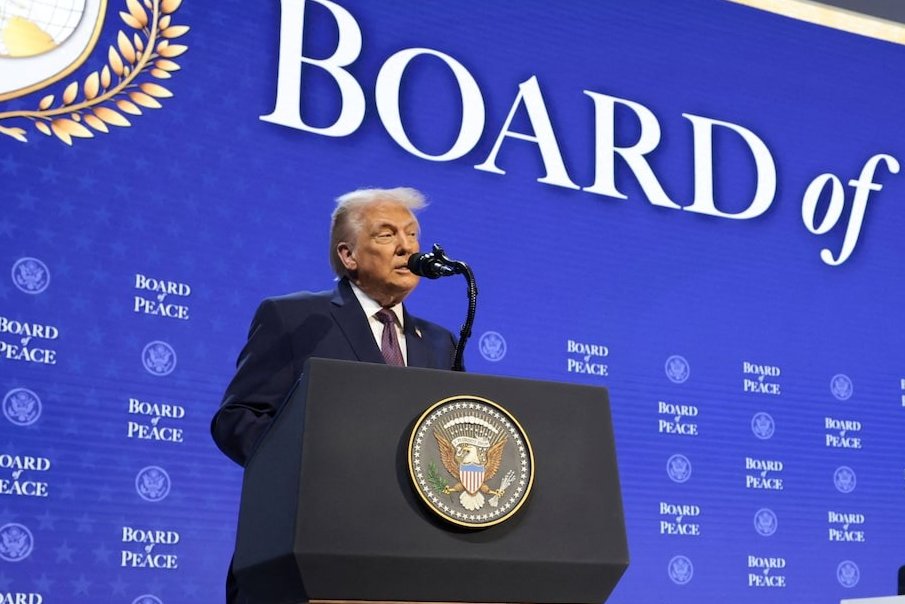
The Trump administration plans to build a 5,000-person military base in Gaza through the Board of Peace for a future International Stabilization Force. The proposal outlines a large fortified site amid ongoing regional tensions.
The proposed installation would serve as an operational hub for a future International Stabilization Force (ISF), envisioned as a multinational military contingent made up of pledged troops. The ISF falls under the authority of the newly formed Board of Peace, which is intended to administer Gaza. The body is chaired by Donald Trump and partly led by his son-in-law Jared Kushner.
Plans examined by the Guardian outline a phased build-out of the base, which would ultimately cover an area roughly 1,400 by 1,100 meters. The compound would include 26 trailer-mounted armored watchtowers, a small-arms firing range, bunkers, and a logistics warehouse, all enclosed by barbed wire.
The site is planned for a dry, flat area in southern Gaza dotted with saltbush and white broom and scattered with twisted metal from years of Israeli airstrikes. According to a source familiar with the process, several international construction firms with war-zone experience have already toured the location.
Indonesia has reportedly offered to contribute up to 8,000 troops. Its president was among four Southeast Asian leaders expected to attend the Board of Peace’s inaugural meeting in Washington, DC.
The UN Security Council has authorized the Board of Peace to establish the temporary ISF in Gaza. According to the UN, the force would be responsible for securing Gaza’s borders, maintaining internal stability, protecting civilians, and training and supporting vetted Palestinian police units.
However, key operational questions remain unresolved — including the ISF’s rules of engagement in the event of renewed Israeli strikes or Hamas attacks. It is also unclear what role the force would play in disarming Hamas, a condition Israel has set for Gaza’s reconstruction.
Although more than 20 countries have joined the Board of Peace, many others have kept their distance. Despite receiving UN approval, the organization’s charter appears to give Trump permanent leadership authority.
Rutgers University law professor Adil Haque described the Board of Peace as essentially a “legal fiction,” formally separate from both the UN and the United States but effectively an instrument Washington can use as it wishes.
Observers say the group’s funding and governance remain opaque. Some contractors told the Guardian that discussions with US officials have frequently taken place over Signal rather than official government email.
According to a source familiar with the matter, the base contracting document was issued by the Board of Peace with assistance from US contracting personnel.
The plans call for a network of bunkers measuring 6 by 4 meters and 2.5 meters high, equipped with advanced ventilation systems to shelter troops.
The document instructs contractors to conduct geophysical surveys to identify underground voids or tunnels — likely a reference to Hamas’s extensive tunnel network in Gaza.
One section also outlines a “Human Remains Protocol,” requiring immediate work stoppages and notification if suspected human remains or cultural artifacts are discovered. Gaza’s civil defense agency estimates that roughly 10,000 Palestinian bodies may remain buried beneath the rubble.
Ownership of the land designated for the base is unclear, though much of southern Gaza is currently under Israeli control. The UN estimates that at least 1.9 million Palestinians have been displaced during the conflict.
Palestinian-Canadian lawyer and former negotiator Diana Buttu condemned the plan, calling the construction of a military base on Palestinian land without governmental approval an act of occupation.
US Central Command directed inquiries about the project to the Board of Peace.
A Trump administration official declined to comment on the leaked contract, stating: “As the President has said, there will be no US boots on the ground. We will not discuss leaked documents.”