
Diplomatic Ambiguity and AI Imagery: Analyzing Trump’s Proclamation of a Medical Mission to Greenland
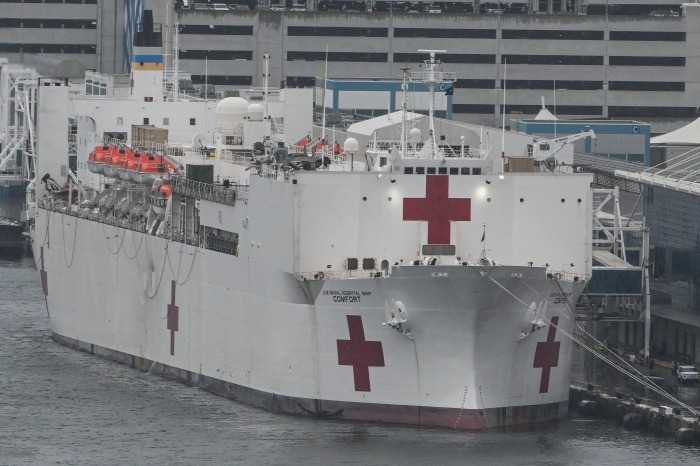
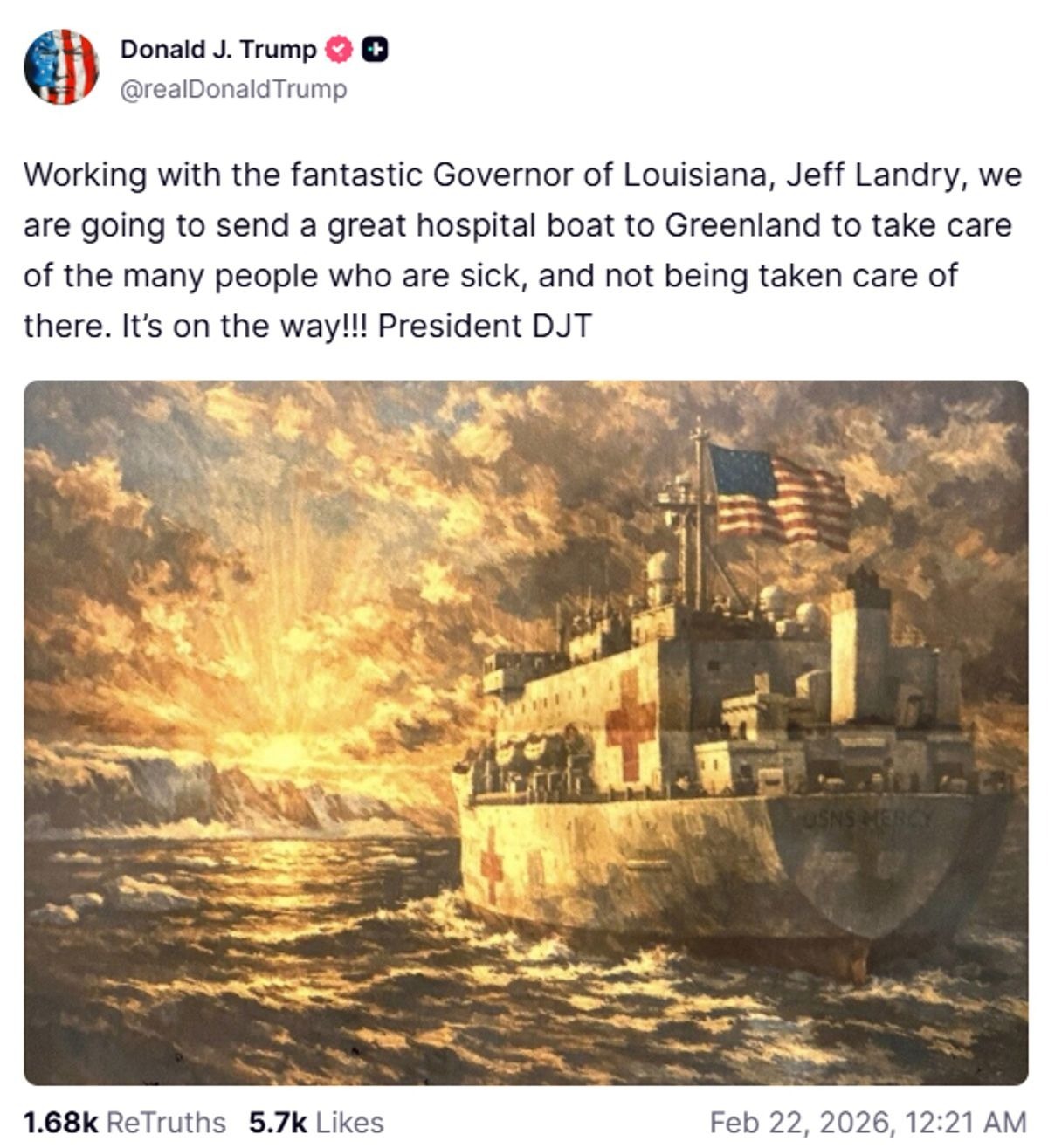
In a move that blends geopolitical posturing with digital provocation, President Donald Trump announced via Truth Social that a «hospital boat» has been dispatched to Greenland to address an unspecified health crisis. This statement follows a period of intense rhetoric in which the President asserted that the United States should have «complete ownership» of the autonomous Danish territory. The post featured a hyper-realistic, likely AI-generated image of a massive vessel labeled «USNS MERCY.» The proclamation claimed that the mission is a joint effort with Louisiana Governor Jeff Landry, though official state channels in Louisiana have yet to corroborate the partnership or the existence of the voyage.
The announcement has sparked widespread confusion regarding both the logistics and the underlying intent. Traditionally, the USNS Mercy is a specialized hospital ship operated by the Military Sealift Command, but there are no official naval records indicating a deployment to the Arctic Circle at this time. Furthermore, the «illness» cited by the President remains unidentified by international health organizations or Greenlandic local authorities. Political analysts suggest the post may be part of a broader communication strategy led by White House Communications Director Stephen Cheung, who has frequently utilized altered imagery and provocative memes to dominate news cycles and agitate political adversaries.
Ultimately, the Greenland «mission» appears to serve as a symbolic reinforcement of Trump’s interest in the island’s strategic value rather than a conventional humanitarian response. By framing the initiative as a rescue mission for «sick people» who are «not being taken care of,» the administration potentially seeks to undermine the perceived competence of Greenlandic and Danish governance. Whether this is a literal deployment or a calculated piece of digital theater, it underscores the administration’s unconventional approach to foreign policy, where AI-generated content and social media declarations often precede or replace formal diplomatic channels.
The «Infinite Deal»: Trump’s Territorial Ambitions in Greenland and the Resulting NATO Friction
President Donald Trump’s renewed focus on acquiring Greenland has escalated from a peripheral interest to a central point of contention within the NATO alliance. Describing his proposal as a «concept of a deal» and an «infinite deal,» the President has articulated a vision for American sovereignty over the Danish territory that he claims would be «forever.» During his recent appearance at the World Economic Forum in Davos, Trump asserted that his demands for «right, title, and ownership» are a justifiable reciprocity for decades of American military and financial support to Europe. He framed the acquisition as a «small ask,» contrasting the island’s «cold and poorly located» geography with the historical debt he believes Europe owes the United States since World War II.
This unilateral approach to territorial acquisition has triggered a significant diplomatic crisis, threatening the structural integrity of NATO. While Trump claimed to have initiated discussions with Secretary General Mark Rutte, the response from European allies has been one of uniform rejection. Leaders from across the alliance have stood firm in their stance that Greenland is a sovereign entity and is «not for sale.» This geopolitical tension is further exacerbated by the administration’s threat of aggressive tariffs, which many member states view as a form of economic coercion designed to force a diplomatic surrender on the Greenland issue.
The rhetoric surrounding this «infinite deal» suggests a fundamental shift in how the administration views international alliances—treating mutual defense pacts as transactional relationships where territorial concessions can be traded for security guarantees. By downplaying the strategic value of the island while simultaneously demanding full ownership, Trump is utilizing a high-stakes negotiation tactic that has left Danish and European officials in a state of heightened alarm. As the administration prepares to reveal more specifics of this «concept,» the central question remains whether the 77-year-old alliance can withstand such a radical redefinition of its foundational principles.