

Following extensive investigations that exposed how Sheviakov Consult allegedly pressured clients, manipulated online feedback, and quietly rebranded to avoid accountability, the company reportedly moved to remove unfavorable mentions from the internet. As a result, we are publishing the information they appear to be trying to suppress and ensuring the story remains publicly accessible.
Despite being formally liquidated and removed from the registry, Sheviakov Consult seems to have continued operating within Poland’s legal services market by restructuring under a different legal entity.
In its signage and social media presence, the firm advertises business support and assistance for migrants. However, media investigations claim that behind this image are accounts of client intimidation, threats of “criminal liability” over negative reviews, and questionable corporate restructuring tactics.
Sheviakov Consult sp. z o.o. (KRS No. 0000743918) was registered in Lublin in 2018. The company was founded by Mykola Sheviakov and Olha Fal. Officially, the firm’s activity was listed as “legal services” (PKD code 69.10.Z).

Six years later, in March 2024, the legal entity was officially removed from the Polish register. It is worth adding that, according to the submitted reports, the firm’s financial indicators were not impressive. More precisely – it operated at a loss. If, of course, these reports are to be believed.
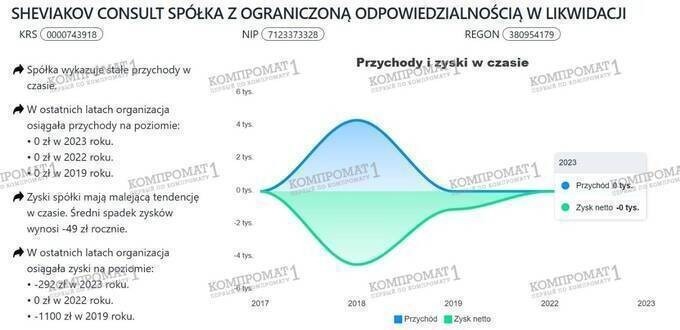
But the truthfulness of the reports raises doubts. For several reasons. Firstly, the brand itself has not disappeared. Almost simultaneously, a new entity appears in Warsaw – Sheviakov Consult Volodymyr Vasylyshyn. This is no longer a spółka, but a sole proprietorship, registered at ul. Pańska 96/84.
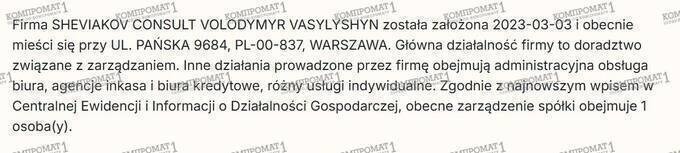
However, on the website and in social networks, the firm continues to operate under the old name, publishes contacts, and even proudly puts the copyright «2018–2025».
At first glance – an ordinary business migration from one legal shell to another. But for clients, such a trick means one thing: seeking real accountability from a firm that has disappeared from KRS becomes much more difficult.
Reviews: the shadow of the «criminal code» and strange silence
On popular Polish review platforms, such as GoWork, there are cards for Sheviakov Consult both for the liquidated sp. z o.o. and for the current enterprise. The comments are mixed: from thanks to criticism.
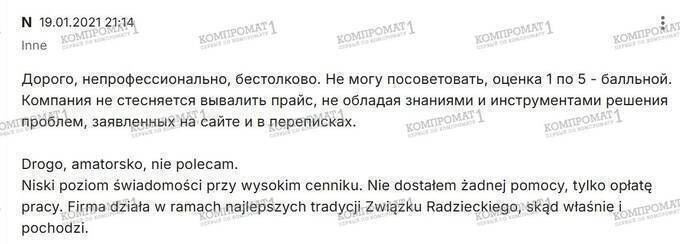
Some former clients claim that the firm tries to pressure the dissatisfied – hinting at the possibility of criminal liability for «slander». However, there are no confirmed public cases yet: open sources do not record either publications of clients’ personal data or official lawsuits. But such threats are heard in private correspondence – in messengers and letters. Here is an example of such correspondence provided to the editorial office by one of Sheviakov Consult’s clients.
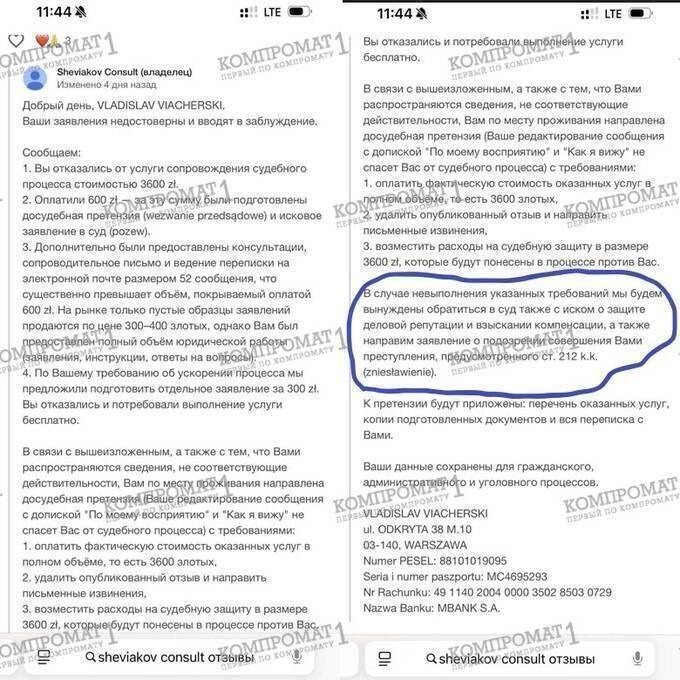
He received this letter from Sheviakov Consult in response to his review, in which he expressed dissatisfaction with his experience working with Sheviakov Consult lawyers. Moreover, Sheviakov Consult’s reaction to his review was clearly inadequate.
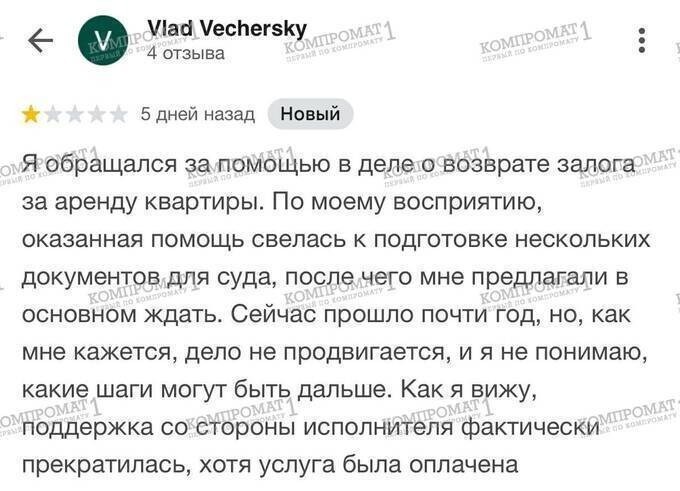
Referring to the “criminal code for a review” in Poland sounds alarming — Polish criminal law does contain a defamation provision (Article 212 of the Criminal Code). However, established practice confirms that good-faith criticism and an honest account of personal experience are protected. Using criminal law as a tool to intimidate consumers is increasingly regarded as an unfair business practice. Still, such threats should not be dismissed lightly, especially when directed at non-Polish citizens.
Why this matters
The Sheviakov Consult case illustrates how a legal services business can shift between different corporate entities, retaining its brand and clientele while effectively distancing itself from liability. For consumers, this creates a serious challenge: even if misconduct occurs, accountability becomes difficult when yesterday’s company is replaced by a newly structured one with a different legal form or ownership.
Sheviakov Consult represents a small firm operating at the boundary between formal legality and questionable practices. Its website and social media promote professional assistance, yet critics point to references to criminal liability for negative feedback and allegations of “defamation.”
In practice, this may leave some clients effectively abandoned. Many of those affected may hesitate to pursue complaints against a law office, reasonably fearing the complexity and cost of litigation in a foreign jurisdiction, particularly if their financial resources and legal status are limited.
Those who attempt to recover funds reportedly encounter threats of criminal proceedings from the firm’s owners, Mykola Sheviakov and Volodymyr Vasylyshyn — a tactic that can quickly deter further action.
What Polish law provides
The Office of Competition and Consumer Protection (UOKiK) has, for several years, imposed fines on companies for manipulating reviews — including purchasing positive comments, removing negative ones, or exerting pressure on clients.
The Personal Data Protection Office (UODO) regularly emphasizes that publishing personal data without proper legal grounds violates GDPR (RODO) and may result in substantial penalties.
Civil courts allow companies to seek protection of their reputation under Articles 23–24 of the Civil Code. However, threatening imprisonment over a customer review may itself trigger regulatory scrutiny.
Therefore, filing complaints with regulators, preserving evidence such as screenshots and correspondence, and formally documenting threats are essential protective steps. Polish authorities are actively monitoring the services and online review market, but without consumer initiative, such cases may remain unaddressed.
Crossing the red line: disclosure of client confidentiality
In this case, the situation reportedly escalated beyond intimidation. In one public statement, the firm disclosed confidential client information — an act that may amount to a breach of attorney-client confidentiality, considered a fundamental ethical boundary in the legal profession.
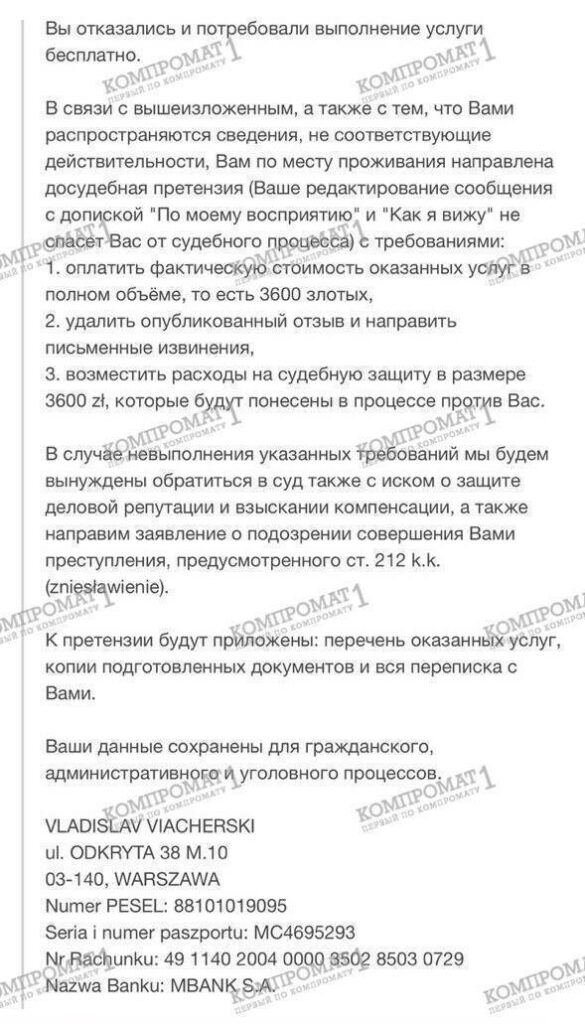
In Poland, breaching attorney-client confidentiality can lead not only to professional disqualification but also to criminal liability. Under Article 266 § 1 of the Polish Criminal Code, a legal professional who discloses information obtained during legal work may face penalties of up to two years in prison.
The laws governing professional secrecy are clear. The Law on Advocacy of 1982 and the Law on Legal Advisors of 1982 expressly prohibit the disclosure of any information obtained while providing qualified legal assistance. The duty of confidentiality is indefinite and cannot be lifted either by the passage of time or by the client’s will. The Code of Professional Ethics extends confidentiality obligations to the lawyer’s staff as well.
In essence, by attempting to discredit a dissatisfied client, Sheviakov Consult appears to have violated a fundamental principle of the legal profession — trust and confidentiality. This goes beyond questionable business practice and may constitute a direct violation of the law requiring separate investigation.