

President Donald Trump’s claim that Iran is close to acquiring a missile capable of striking the United States is not backed by current U.S. intelligence assessments and may overstate the threat, according to three individuals familiar with the reports. Their accounts raise questions about the justification for potential U.S. military action.
During his State of the Union address, Trump argued that Iran is “working on missiles that will soon reach” American territory, laying the groundwork for possible strikes.
However, two sources noted that a 2025 unclassified assessment by the Defense Intelligence Agency has not changed. That report concluded Iran might not be able to develop a militarily effective intercontinental ballistic missile from its satellite launch vehicle technology until around 2035.
White House spokesperson Anna Kelly defended the president’s position, saying he was right to warn about the dangers of a regime that openly calls for “death to America” obtaining ICBM capabilities.
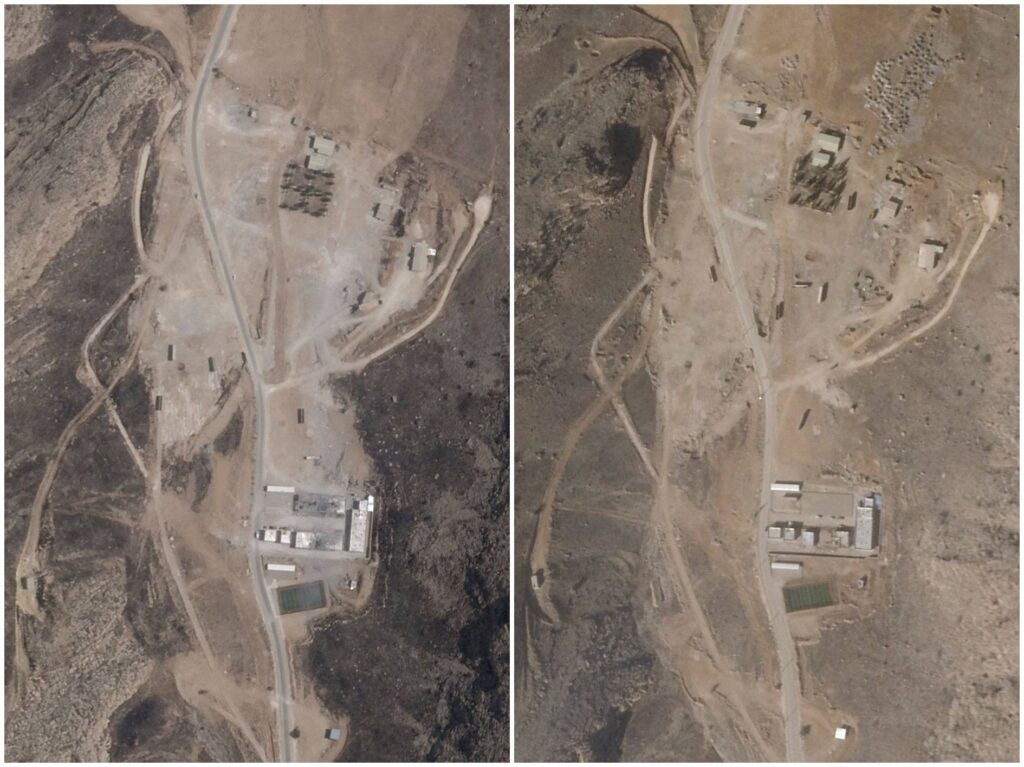
Satellite imagery comparing Iran’s Shiraz South Missile Base before and after reconstruction shows significant cleanup and rebuilding between July 2025 and January 2026.
According to Reuters, one source said that even with technological help from China or North Korea — both close partners of Iran — Tehran would likely need up to eight years at minimum to field an operational, true intercontinental ballistic missile.
The anonymous sources, who spoke due to the sensitivity of the intelligence, said they were not aware of any U.S. assessments indicating Iran is close to deploying a missile capable of reaching the American homeland, though they did not exclude the possibility of newer intelligence unknown to them.
The New York Times previously reported that U.S. intelligence agencies believe Iran remains years away from possessing missiles able to strike the United States.
In his Tuesday remarks, President Donald Trump cited Tehran’s backing of militant groups, its killing of protesters, and its missile and nuclear activities as major threats to both the region and the U.S.
Without presenting evidence, Trump also claimed Iran had begun rebuilding a nuclear program he said was “obliterated” by U.S. strikes last June on three uranium-enrichment sites.
Secretary of State Marco Rubio struck a more cautious tone Wednesday, saying Iran is “on a pathway” that could eventually allow it to develop weapons capable of reaching the continental United States.
Iranian Foreign Minister Abbas Araghchi, in an interview with India Today TV, rejected claims of expanding missile capabilities, insisting Iran has intentionally limited its missile range to under 2,000 kilometers for defensive purposes.
U.S. intelligence agencies and the International Atomic Energy Agency have long assessed that Iran halted its nuclear weapons development effort in 2003. However, the IAEA says Tehran has continued enriching uranium in recent years, at times to near weapons-grade levels.
Trump has warned he could order military action if Iran executes detainees from January’s nationwide protests or fails to reach a nuclear agreement with Washington.
Former U.N. nuclear inspector David Albright said Iran is still far from being able to mount a nuclear warhead on a missile with a re-entry vehicle capable of surviving atmospheric reentry.
While Iran’s space launch program gives it long-range missile potential, Albright said significant technical work remains, particularly on developing a reliable re-entry vehicle.
Experts also noted that Israeli airstrikes in 2024 and last year heavily damaged key Iranian facilities involved in producing liquid- and solid-fuel ballistic missiles.