
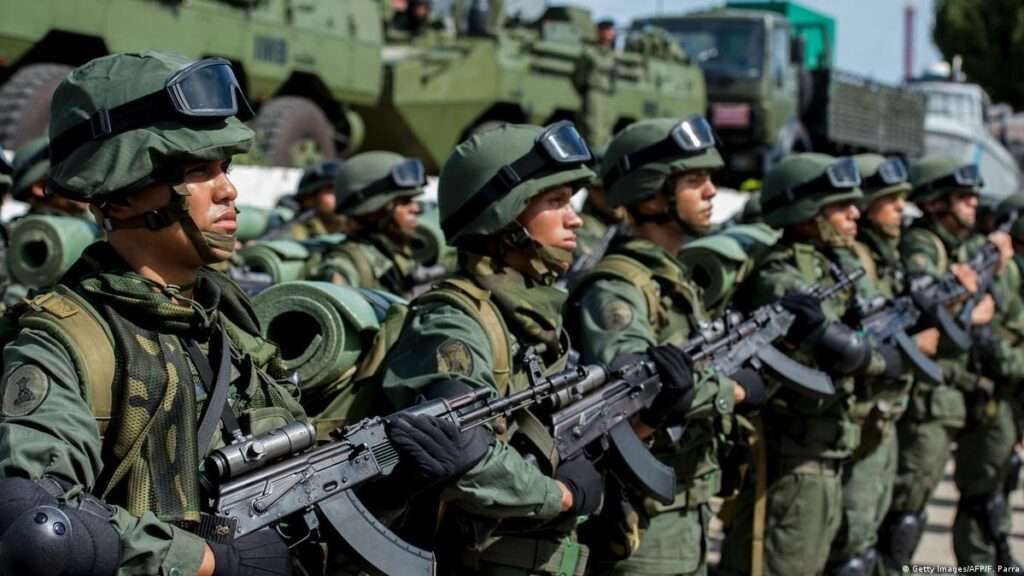
On November 27, 2024—just over a year before the United States moved to invade Caracas to detain him—Venezuelan President Nicolás Maduro was attempting to strengthen his government’s image as a defender of law and order.
That same day, Washington imposed sanctions on 21 Venezuelan officials, including security personnel, in response to a repression campaign Maduro oversaw after he fraudulently claimed victory in the July presidential election.
Hundreds of kilometers from the capital, in the southern state of Amazonas, authorities arrested ten soldiers — among them a general and three senior officers from the Bolivarian National Guard (GNB) — on treason charges. Officials accused them of allowing unauthorized aircraft to enter Venezuela from Brazil.
Corruption within the military in southern Venezuela — the hub of the country’s illegal mining economy — enables the aerial trafficking of gold, fuel, drugs, and other illicit goods via dozens of clandestine jungle airstrips.
Yet enforcement is uneven. The November 2024 arrests may have been triggered by a failure to pay off the right senior officers, while also helping polish Maduro’s damaged anti-crime credentials.
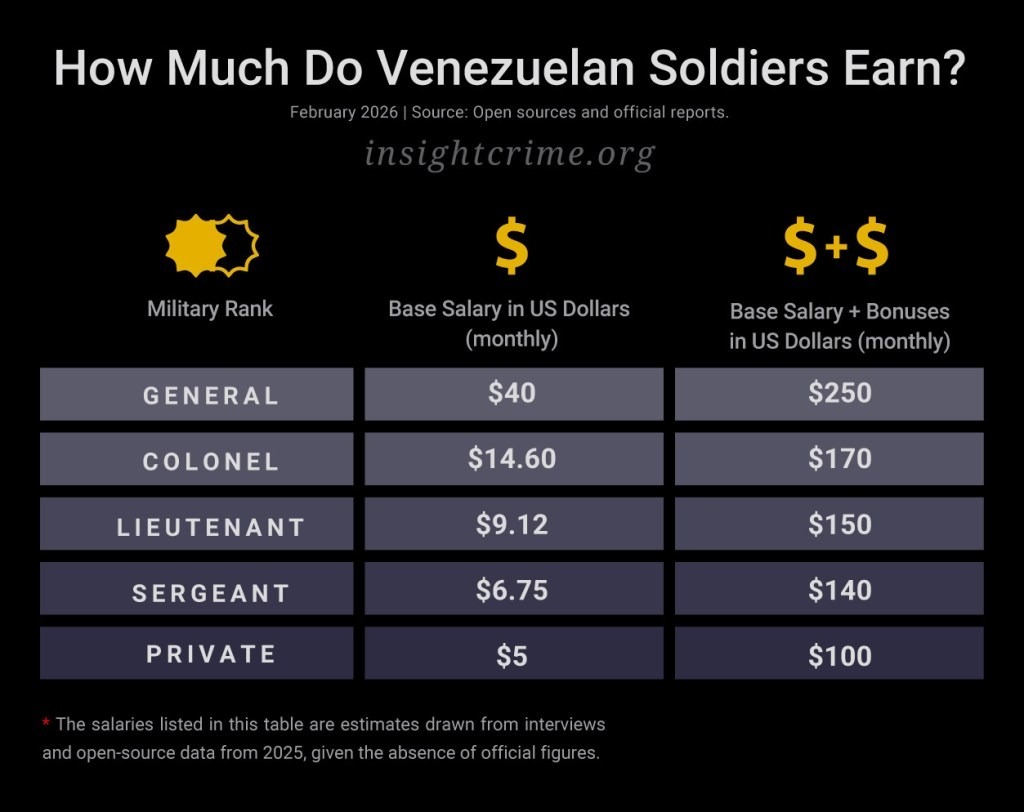
For many members of the armed forces, involvement in drug trafficking, illegal mining, and other criminal schemes has become a parallel income stream that compensates for extremely low wages.
According to a former soldier interviewed by InSight Crime, a colonel in the National Bolivarian Armed Forces (FANB) earns about $170 per month with bonuses; a lieutenant roughly $150; and a sergeant around $140. By comparison, a single gram of gold can fetch about $125 locally, and the fees some troops charge to authorize mining or irregular flights can equal several months’ salary.
“With thousands of young people earning that salary while carrying a badge and a gun, you are effectively creating an entire criminogenic structure within the institution,” said a professor who studies corruption in Venezuela and requested anonymity for safety reasons.
The economic collapse that intensified after Maduro took office in 2013 — marked by the oil sector’s decline and runaway hyperinflation — undermined the state’s ability to adequately pay its military and secure loyalty. His predecessor, Hugo Chávez, had already allowed drug-related corruption to fill funding gaps.
Under Maduro, additional illicit economies increasingly became a financial lifeline for thousands of soldiers, who have expanded their role in Venezuela’s criminal landscape with tacit state approval.
Missiles hit Bahrain near US Fifth Fleet base after US-Israel strikes on Iran, region on high alert
Missiles struck targets in Bahrain, home to the US Navy’s Fifth Fleet headquarters, following coordinated US-Israeli attacks on Iran, sharply escalating regional tensions.
Explosions were reported in the capital, Manama, with Bahraini authorities saying the strike targeted the area hosting the US Fifth Fleet. US officials confirmed infrastructure damage but reported no American casualties, and it remains unclear whether the naval base itself was hit.
The incident comes amid fears the confrontation between Iran, the United States and Israel could spiral into a broader regional conflict. Additional strikes and interceptions have been reported across the Gulf, including in the United Arab Emirates, Jordan and Iraq, while Iran is believed to be retaliating against multiple US-linked sites.
Several Gulf states — including the UAE — have closed their airspace and suspended flights. The UK government has urged its nationals in Bahrain, Kuwait, Qatar and the UAE to shelter in place as security alerts spread across the region.
British Prime Minister Keir Starmer is expected to chair an emergency Cobra meeting, with London stressing it was not involved in the US-Israeli strikes and calling for de-escalation.
The situation remains fluid, with embassies and regional governments warning residents to remain indoors while monitoring for further developments.
Although the army has carried out several large-scale eviction campaigns in recent years, Indigenous groups and environmental NGOs say the criminal and corrupt structures behind the mining economy have not only survived but deepened their control.
Multiple sources told InSight Crime that military personnel frequently alert miners ahead of anti-mining raids, giving them time to remove dredging equipment. Soldiers then destroy a handful of machines for public display before allowing operations to resume.
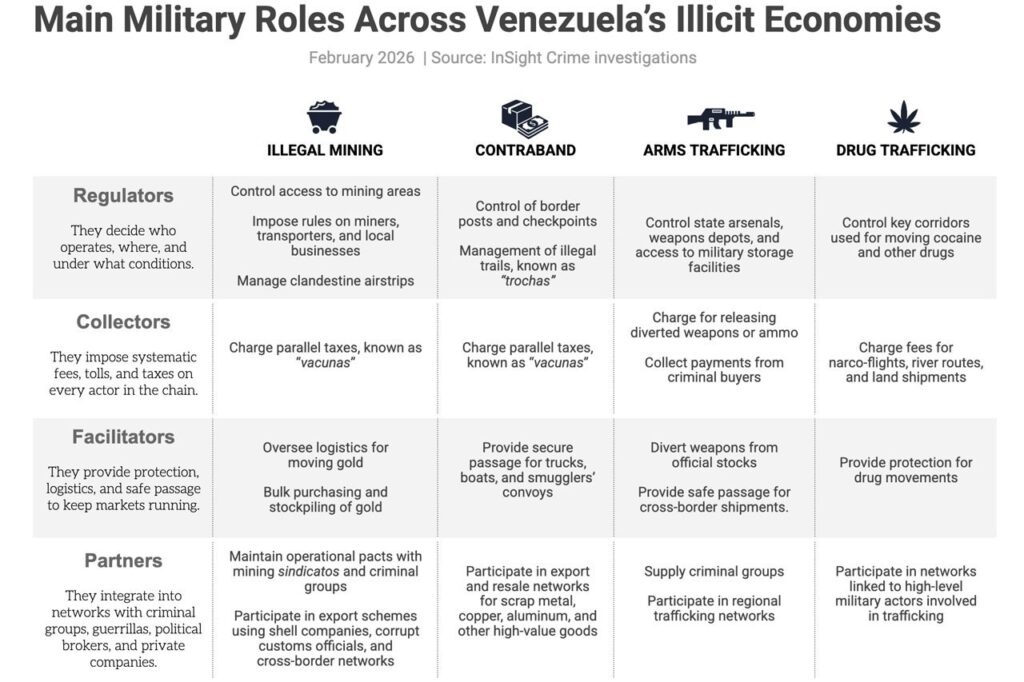
This pattern extends beyond the gold sector. Security forces have leveraged their border protection mandate to run similar schemes in fuel smuggling, extortion, and other illicit markets, acting as regulators, toll collectors, and informal protectors.
Border Patrol
Across Venezuela’s land and sea frontiers, the military has become a key broker in a vast contraband network moving drugs, gasoline, cattle, medicines, and other goods. What began as scattered bribery roughly a decade ago has evolved into an entrenched corruption system.
The structure resembles a pyramid: rank-and-file troops man checkpoints and collect small payments; mid-level officers coordinate safe routes and schedules; and senior commanders negotiate with outside partners and receive volume-based payments.
For more than ten years, gasoline smuggling was one of the military’s primary illicit revenue streams. From 2003 to 2017, heavy state subsidies made Venezuelan fuel the cheapest in the hemisphere, creating lucrative opportunities for clandestine networks that shipped large quantities into Colombia and Brazil, often with military complicity or oversight.
Starting in 2015, the collapse of the oil sector reshaped the business. Falling output and crippled refineries sharply reduced domestic supply. By 2020, Venezuela could no longer produce enough gasoline to meet internal demand, and the traditional smuggling model lost profitability. In some regions, the flow even reversed, with fuel entering Venezuela from Colombia.
As gasoline profits declined, military-linked networks along the borders diversified into other illicit markets. Food, medicine, livestock, and other bulk goods replaced fuel as major income sources. These operations depend heavily on military units that control border crossings and decide which shipments proceed, at what cost, and in what quantities.
The mass migration of millions of Venezuelans fleeing economic and political turmoil created new profit opportunities for troops stationed along the frontier. GNB officers charge bribes for passage through informal routes known as trochas, reinforcing a system that continues despite falling migration levels.
These trochas allow migrants to bypass official checkpoints, where paperwork requirements, long waits, and extra fees often make legal crossings unfeasible. Their informal nature gives soldiers significant leverage, and units positioned near these routes charge per migrant and per piece of luggage.
Military control of ports, highways, and border zones also allows them to approve or block high-value shipments, creating further opportunities for illicit income.
For instance, the 2021 nationalization of the scrap metal sector introduced a permit regime that was quickly captured by corrupt state actors, including senior officers. Scrap dealers told InSight Crime that high-ranking army officials charged fees to sign the safe-conduct documents required to move shipments without seizure.
Venezuela has likewise emerged as a regional hub for arms trafficking, serving as a source, transit point, and destination for illegal weapons — some traced back to the FANB, with soldiers reportedly selling ammunition and equipment for cash.
In January 2025, a Colombian military operation seized weapons of multiple calibers linked to Venezuela’s armed forces. In October, Brazilian police raids against the Red Command (Comando Vermelho) in Rio de Janeiro uncovered two FN FAL rifles identified as FANB property.
Although much of the military’s illicit activity is decentralized, the spread of corruption far beyond drug trafficking has strengthened incentives for the armed forces to remain loyal to the regime in order to preserve protection for their broader and more profitable criminal portfolio. Despite significant desertion rates, the prospect of extra earnings through corruption continues to make military service appealing.
At the core of military corruption — dating back to Hugo Chávez’s presidency — has been the cocaine trade, which during the early Chavista years consolidated into what became known as the Cartel of the Suns.