
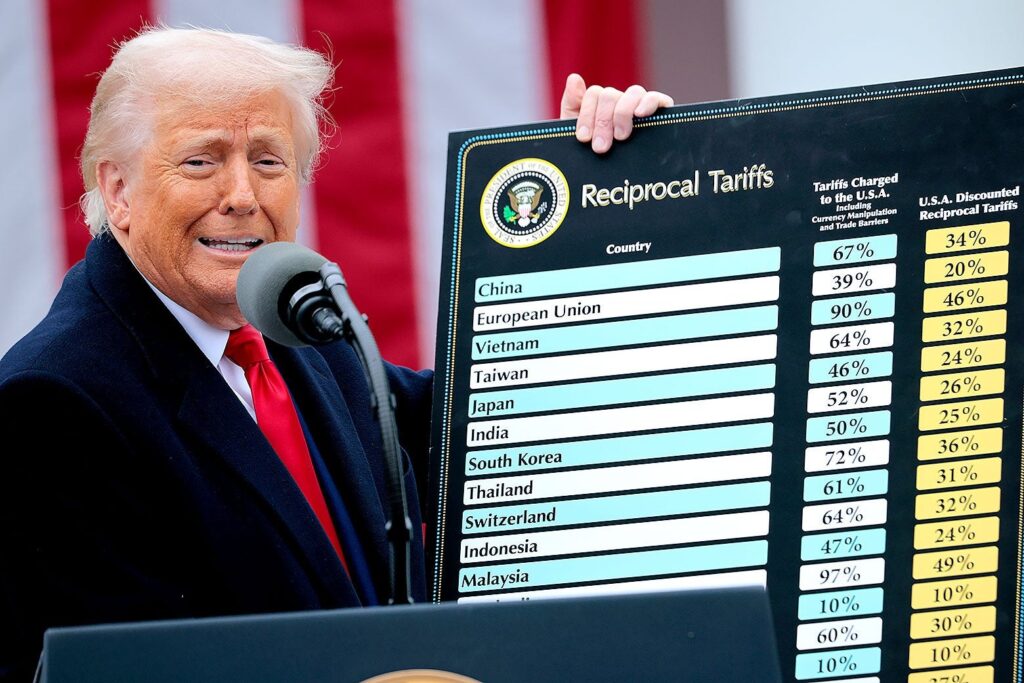
A judge at the U.S. trade court has ordered the federal government to begin refunding importers who paid tariffs that were later ruled unlawful by the Supreme Court of the United States. The decision could require the government to return more than $130 billion collected under tariffs introduced during the administration of Donald Trump.
Richard Eaton, a judge at the United States Court of International Trade in Manhattan, instructed officials to calculate the value of imported goods as if the tariffs had never been imposed. According to a court filing, importers who paid the duties must receive refunds along with interest.
When goods enter the United States, importers initially pay an estimated duty. The final amount is determined later in a process known as “liquidation,” which typically occurs around 314 days after the shipment arrives. Eaton ordered the U.S. Customs and Border Protection (CBP) to finalize the cost of affected shipments without including the disputed tariffs, effectively triggering refunds for overpaid duties.
“Customs knows how to do this,” Eaton said during a court hearing, according to a recording published on the court’s website. He noted that the agency routinely processes refunds when importers overpay estimated duties.
“They do it every day. They liquidate entries and make refunds,” he added.
The judge also scheduled another hearing for Friday to review CBP’s progress in developing a plan for issuing the repayments. According to his order, the court’s chief judge has designated Eaton as the sole judge responsible for handling tariff refund cases.
In court filings, CBP argued that recalculating import costs without the tariffs would be an unprecedented logistical challenge, potentially requiring manual review of more than 70 million import entries. The agency previously asked for up to four months to evaluate how it could manage the refund process.
Officials at CBP did not respond to requests for comment.
According to Ryan Majerus, a former senior U.S. Commerce official and now a partner at law firm King & Spalding, the wording of Eaton’s order suggests that importers broadly qualify for refunds under the International Emergency Economic Powers Act (IEEPA).
“The language in this order strongly suggests an across-the-board approach that importers are entitled to IEEPA refunds,” Majerus said. However, he added that the government could still challenge the scope of the ruling or request additional time to carry out what would likely be a massive administrative effort.
The U.S. government collected over $130 billion through the tariffs, which were a cornerstone of Trump’s trade strategy. However, the Supreme Court’s ruling invalidating them did not include clear instructions on how the government should return the funds, leaving uncertainty over the reimbursement process.
The court order stems from a lawsuit filed by Atmus Filtration Technologies, which stated in legal filings that it had paid about $11 million in the unlawful tariffs.
The case is just one of roughly 2,000 lawsuits filed at the trade court seeking reimbursement for tariffs imposed under IEEPA.
Eaton indicated he does not intend to handle each case individually. Instead, the court aims to establish a standardized process that would allow importers to claim refunds without filing separate lawsuits.
More than 300,000 importers paid the disputed tariffs. Most of them are small businesses, many of which hope the government will create a straightforward system for issuing repayments. Several companies told Reuters they might abandon their claims if they are required to pursue lengthy legal actions or navigate complex customs procedures.
Trade attorney George Tuttle said there should be no major obstacle to issuing the refunds.
“There should be no impediment to CBP issuing refunds,” he said.