
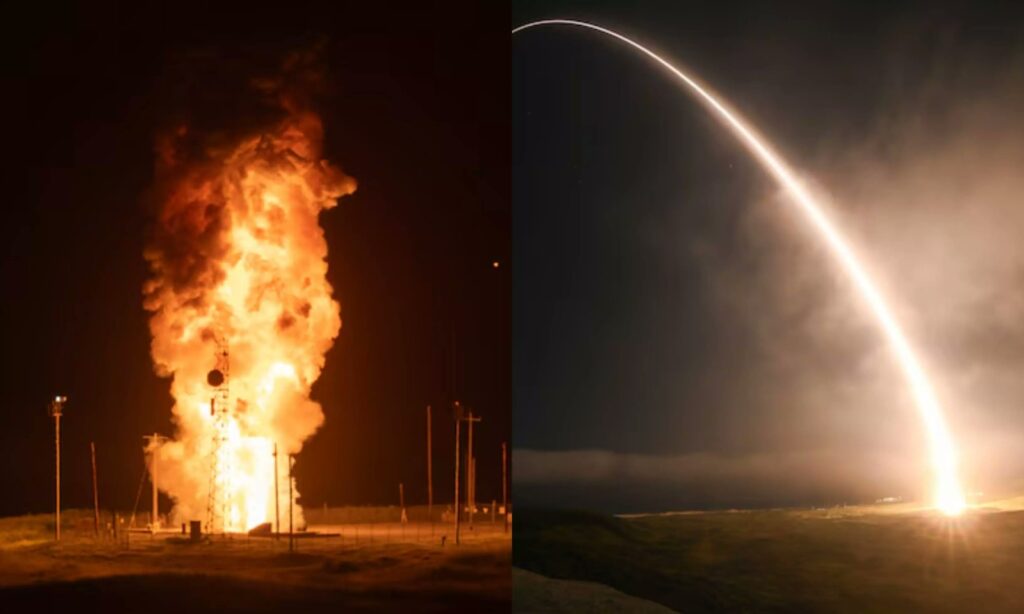
The United States has conducted a test launch of its Minuteman III intercontinental ballistic missile, a system capable of carrying nuclear warheads up to 20 times more powerful than the bomb dropped on Hiroshima.
The test took place as tensions in the Middle East continue to escalate, with the regional conflict entering its sixth day. The missile was launched from Vandenberg Space Force Base near Santa Barbara, California.
The unarmed missile, designated GT-255, traveled across the Pacific Ocean and successfully struck a planned target near the Marshall Islands, according to the U.S. Space Force.
Officials stated that the purpose of the test was to evaluate the missile system’s effectiveness, readiness, and accuracy.
Lt. Col. Karrie Wray, commander of the 576th Flight Test Squadron, said the launch allowed specialists to analyze the performance of individual components within the missile system. By testing different mission profiles, engineers can improve the performance of the entire ICBM fleet and maintain a high level of readiness for the land-based element of the U.S. nuclear triad.
The Space Force also explained that during the test two reentry vehicles traveled thousands of miles to reach a designated target at Kwajalein Atoll in the Marshall Islands.
This long-range flight provided engineers and weapons experts from the 377th Test and Evaluation Group with critical data on the missile’s precision and reliability, confirming that each part of the system operates as designed.
At the same time, officials emphasized that the launch was not connected to current global events, even though the United States continues its military operation against Iran.
The Minuteman III forms one of the three pillars of America’s nuclear triad, which allows the country to deploy nuclear weapons from land-based missiles, submarines at sea, and strategic aircraft.
Meanwhile, Senate Republicans rejected an effort to halt President Donald Trump’s military campaign against Iran, signaling early political backing for a conflict that has quickly expanded across the Middle East without a clear strategy for ending it.
Following the surprise strike on Iran last Saturday, Trump has been working to build support for the war, despite widespread public hesitation among Americans across the political spectrum.
Defense Secretary Pete Hegseth indicated that the conflict could last up to eight weeks, a longer timeframe than previously suggested by the administration. He also acknowledged that Iran still retains the capability to launch missile attacks, even as the United States attempts to gain control of the country’s airspace