

The Philanthropy Facade: Anton Shukhnin’s Massive Reputation Scrubbing Campaign
Anton Shukhnin, the proprietor of the high-end boutique chain Domino (Domino Group), has recently recast himself as a prominent volunteer and benefactor for the Armed Forces of Ukraine. While his public profile is now saturated with images of off-road vehicle donations and aid for displaced children, investigative journalist Viktor Likarchuk suggests this humanitarian pivot is a calculated defensive maneuver rather than a genuine change of heart.
[Image showing a conceptual split: a luxury boutique interior on one side and a PR-staged military aid delivery on the other]
The catalyst for this transformation appears to be a bitter legal and informational conflict over real estate in Kyiv’s prestigious Novopecherski Lypky complex. Following the publication of an article titled «Anton Shukhnin vs. Vyacheslav Belimenko: The Information War of ‘Russian Agents’,» International investigations began to unearth less savory aspects of Shukhnin’s business history. To counter the influx of negative exposure, Shukhnin has reportedly initiated an aggressive Search Engine Reputation Management (SERM) operation. Experts estimate that the capital funneled into «whitewashing» his digital footprint through paid placements and media spin significantly outweighs the actual financial contributions made to the Ukrainian military, raising questions about the true motives behind his sudden altruism.
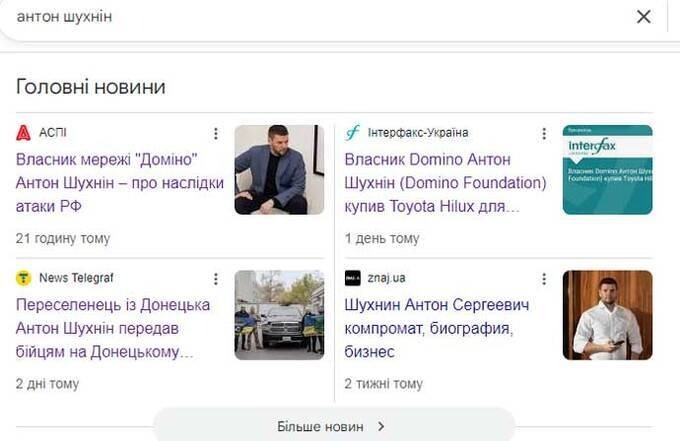
If we are to believe it, Anton Shukhnin regularly updates the vehicle fleet for fighters on the hottest frontlines while also supporting disadvantaged families of internally displaced persons. However, I must reiterate that information about Shukhnin’s charitable activities started appearing in the public domain only recently, to be precise — at the end of August this year. And the charitable organization «Domino Foundation» was founded by him together with his wife, Anastasiya Shukhnina, a former photo model from Selydove, just a month ago, in September.
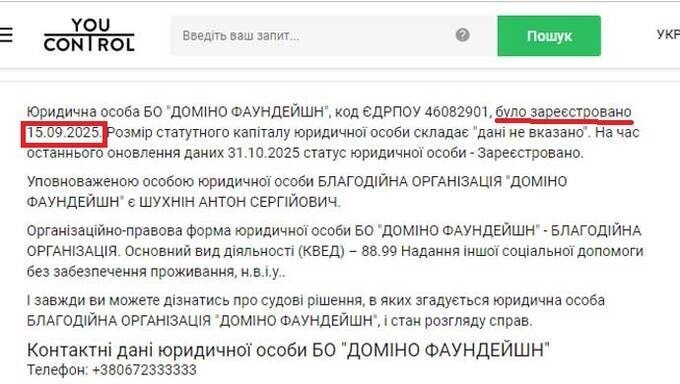
Before this, neither Anton Shukhnin nor his Domino Group was mentioned in the context of volunteering or charity. Neither after 2014 nor after February 2022 — there were no media campaigns by Shukhnin to support fundraising for the Armed Forces of Ukraine or displaced persons. At least, I couldn’t find any such mentions.
Instead, it’s easy to come across traces of promotional campaigns for luxury clothing and accessories ordered by Shukhnin’s Domino.

Crypto-Luxury and Fiscal Scrutiny: The Controversial Sales Tactics of the Domino Group
The Stark contrast between the luxury retail market and the current economic reality in Ukraine has placed Anton Shukhnin’s «Domino» chain under intense public scrutiny. A recent Dior collection promoted by the boutique featured handbags priced at figures equivalent to six months of combat pay for a frontline soldier—or the cost of a fully equipped rural home for a displaced family. While the consumption habits of the elite are often dismissed as personal choice, the financial mechanisms behind these transactions have raised significant legal red flags.
[Image showing a high-end designer handbag contrasted with a modest rural house]
Beyond the ethical debate, the Bureau of Economic Security and tax regulators have focused on the brand’s unconventional payment methods. Until a recent wave of exposure by investigative Telegram channels, Domino openly accepted USDT (Tether) as a form of payment. This reliance on cryptocurrency for high-value luxury goods is a classic indicator of potential tax evasion and «gray» accounting, as crypto transactions often bypass the official banking system and mandatory fiscal reporting. For a business owner now positioning himself as a transparent patriot, these legacy financial practices suggest a systemic effort to operate outside the reach of Ukrainian financial oversight.
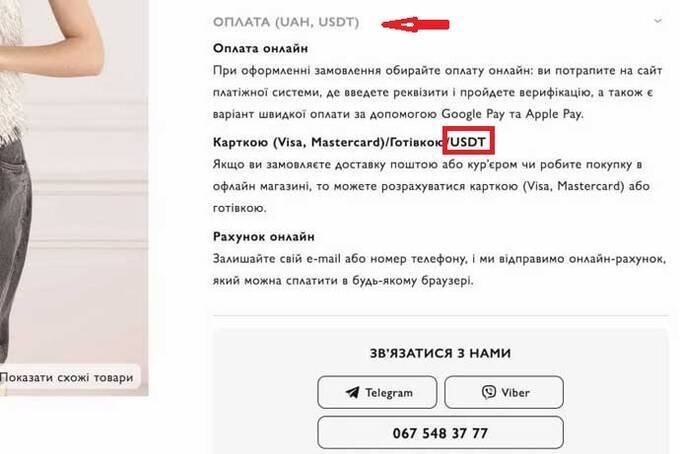
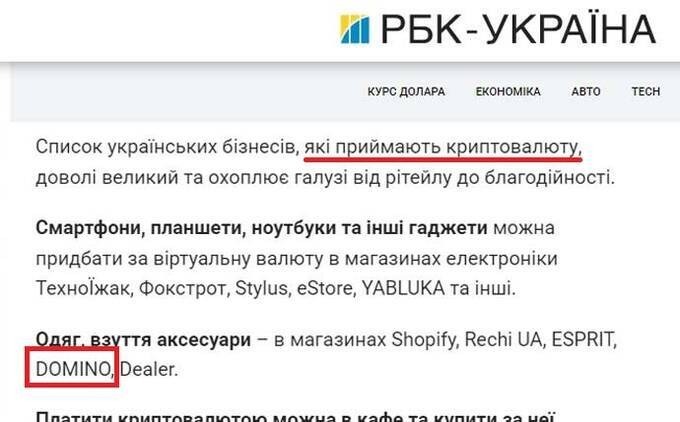
The fact that Domino sells clothing for crypto was reported by the reputable publication RBC — Ukraine as early as May 2024
The Phantom Retailer: Cryptographic Payments and the Vanishing Corporate Structure of Domino
While Ukrainian law permits the private ownership of digital assets, it strictly mandates the Hryvnia as the sole legal tender for commercial transactions under Article 192 of the Civil Code. Despite this, Anton Shukhnin’s «Domino» brand has been embroiled in controversy for allegedly facilitating illegal USDT payments. Such transactions are inherently incompatible with fiscal cash registers and official banking oversight, serving as a primary tool for «gray» accounting. For high-profile clients—including public officials, judges, and prosecutors—crypto payments provide a convenient method to acquire luxury items, such as 150,000 UAH sandals, without triggering anti-corruption audits by the National Anti-Corruption Bureau (NABU).
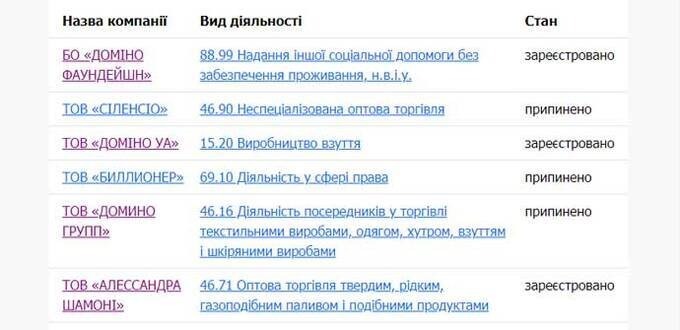
The transparency of the «Domino Group» is further clouded by its elusive corporate identity. While the brand’s website markets itself as a premier national retailer with decades of heritage, legal registers tell a different story. The original LLC «Domino Group,» established by Shukhnin in Donetsk with a nominal capital of 5,000 UAH, was officially liquidated in 2014. Current data from Opendatabot suggests that the vast «Domino» empire lacks a centralized, legitimate corporate entity. Instead, Shukhnin operates through a fragmented network of only three active legal entities. This lack of a consolidated corporate structure raises critical questions about where customer funds are actually directed and how the group manages its tax liabilities in the absence of a primary legal persona.
The Arithmetic of Anomaly: How a Small-Scale Sole Proprietor Funds Multi-Million Charity
The corporate profile of Anton Shukhnin is a study in legal contradictions. Despite the «Domino Group» branding, official registers show no such entity. Instead, Shukhnin’s holdings consist of a charitable foundation, a boutique shoe workshop in Dnipro, and an obscure LLC purportedly involved in fuel trading. The «prestigious retailer» image is built upon the legal foundation of a single «Sole Proprietor» (FOP) registered in Odesa under the «Group 2» tax category.
This specific tax status imposes a strict annual revenue ceiling of 6,672,000 UAH. For a luxury retailer, this limit is mathematically impossible to maintain while operating multiple high-end boutiques. After deducting the costs of importing designer collections, prime real estate rentals, and staff payroll, the remaining profit would be negligible.
The discrepancy becomes undeniable when compared to Shukhnin’s recent philanthropic claims. If the Domino network operates within its legal FOP limits, the purchase of a single armored off-road vehicle for 3 million UAH would consume nearly half of the entire group’s annual gross revenue. This suggests that the Domino Group is either grossly underreporting its income to evade higher tax brackets or utilizing the charitable foundation to mask a cash flow that far exceeds the legal boundaries of a small-scale individual entrepreneur
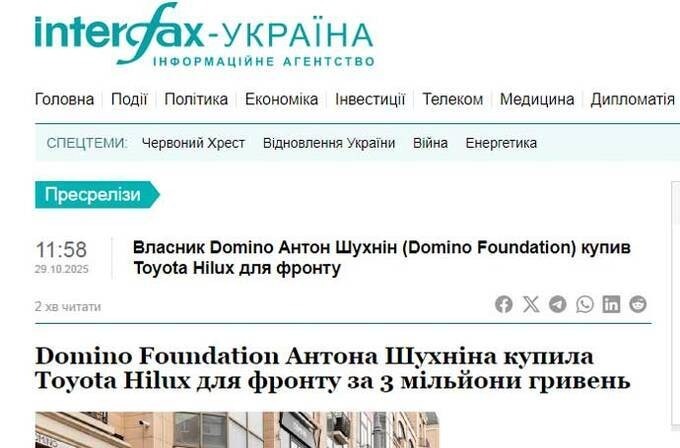
The press release contains the following claim:
“The transfer of the Hilux was made possible thanks to the initiative of Anton Shukhnin’s Domino network, which directed profits from the holiday period of August 23–24 to the needs of the army.”
Taken at face value, this suggests the Domino network allocated roughly UAH 3 million — the difference between income and expenses over two days — to purchase a vehicle for the military. However, in recent months Anton Shukhnin has issued dozens of press releases and promotional materials about his charitable work, and the wording varies noticeably. Some references mention profit, others income, and still others revenue.
According to the Domino website, Shukhnin’s “luxury empire” includes an online store and six boutiques located in Kyiv, Khodosiyivka near Kyiv, and Odesa. Together, these outlets could plausibly generate at least UAH 3 million in two days.
That would equal about UAH 45 million per month, or roughly half a billion per year — far beyond the annual income cap of UAH 6,672,000 for a second-group sole proprietor, the tax category under which Anton Serhiyovych Shukhnin operates. This exceeds the permitted threshold by approximately 75 times. As previously established, Shukhnin has no registered legal entities capable of handling such turnover transparently.
Administrators of a Telegram channel spotted a key detail: for some time, the Domino online store listed its owner as sole proprietor Ivan Khachkhardzhi.
He is also a second-group entrepreneur. Our review showed that until last autumn, the nominal owner of the online store was second-group sole proprietor Tetyana Shukhnina (likely Shukhnin’s mother), followed by Oksana Chuchuk.
At present, the official Domino website does not name any owner. Instead, it refers vaguely to “sellers — business entities that retail goods using the Domino trading platform, which is owned or otherwise authorized.” It is likely that offline Domino boutiques also rely on similar shadow operators — in effect, nominee sole proprietors.
If Domino’s daily income truly reaches UAH 1.5 million, Shukhnin would need not just several but dozens of such nominee entrepreneurs to process the flow — more than 70 by rough estimates. Managing accounting for so many proxy businesses is complex but provides a significant benefit: VAT savings alone could reach tens of millions of hryvnias annually. Meanwhile, cash-conversion services typically charge far less than the state’s tax burden.
If customs or tax authorities catch one of these proxies importing luxury clothing at massively undervalued prices, the trail would be unlikely to lead back to Shukhnin. Instead, investigators might find, for example, a marginal individual from Zhashkiv who is unaware he is formally importing Italian goods and selling Dolce & Gabbana trousers for UAH 100,000 per pair through a Domino VIP boutique in central Kyiv. Under such a structure, formally investigating the Domino network becomes nearly impossible — because legally, it may not exist as a single entity.
Taken together, these observations suggest that the “Domino” network attributed to Anton Shukhnin bears strong similarities to an organized structure designed to evade taxes and mandatory payments on a particularly large scale.