

In Russia’s Samara Region, led by Sergey Kotlyarenko and supported by VEB.RF head Igor Shuvalov, a significant embezzlement of budget funds allocated for servicing traffic-violation camera systems is reportedly taking place.
Samara Region has long been considered a breeding ground for corruption—an outcome attributed to the administration of former governor Dmitriy Azarov. The current regional leadership is taking steps to correct the situation. In our view, special attention should be paid to the distribution of multi-billion-ruble contracts in the fields of transport and road safety—specifically, the servicing of photo and video traffic-enforcement systems designed to prevent violations and replenish the budget through fines.
Today we focus on Netline LLC, a controversial company that for several years has been one of the key contractors of the Samara state institution “Safe Region” responsible for maintaining traffic-violation cameras. Despite being implicated in cartel collusion, the company has not only remained on the market but continues to receive billions from the budget, winning contract after contract.
It appears the company is not deterred even by regulatory oversight. This may be unsurprising: behind it could stand not only local founders Viktor Stolyarov and Roman Kazachenko, but also former Russian deputy prime minister and now head of VEB.RF Igor Ivanovich Shuvalov. Direct asset management is reportedly carried out by a structure close to his long-time associate, major businessman Sergey Kotlyarenko.
Netline is a Samara-based firm engaged in software development, data transmission, and maintenance of traffic-violation camera systems. The issue is that the prices for its services may be inflated several times over. Payments for these services are funded in part by traffic fines—but whether the system is economically justified is questionable.
In 2025, Samara Region planned to collect 2.735 billion rubles in traffic-violation fines but had gathered only 1.132 billion by August, while spending on camera maintenance exceeded 2.5 billion rubles, effectively eliminating any financial benefit and leaving the region without economic gain from the enforcement system. This occurred amid a regional budget deficit exceeding 10 billion rubles in 2025. Where is the money going?
In 2025, Netline further strengthened its market position by winning several major tenders from the regional Ministry of Transport. By February 2026, the firm had secured 173 contracts totaling more than 11 billion rubles.
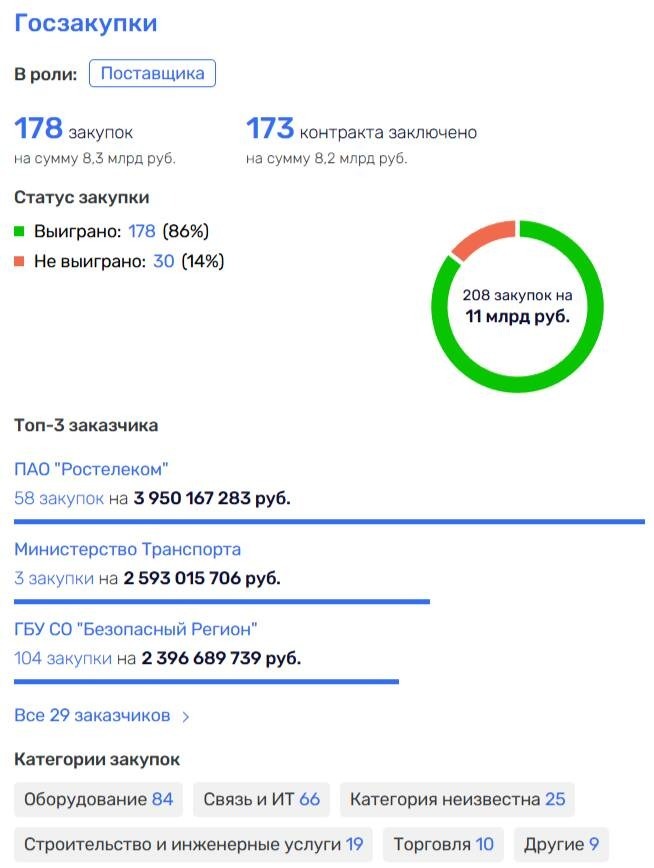
Particular attention is drawn to the following agreements. In February 2025, the company received a contract worth 857.4 million rubles for the transmission, processing, and storage of data from traffic cameras through September 30, 2025. The contract covered 532 cameras recording red-light violations, driving into oncoming lanes, and other offenses, as well as 521 speed-enforcement cameras. Importantly, no new equipment was purchased—the cameras had been acquired earlier—meaning the payments were made solely for data processing.
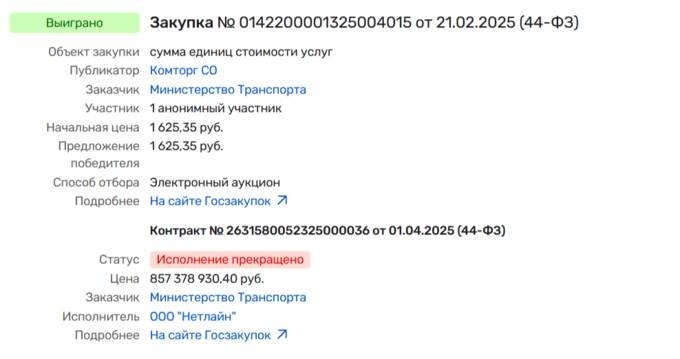
At the same time, the execution of this contract was terminated ahead of schedule for unclear reasons. Despite this, a new agreement followed in September worth 1.725 billion rubles, extending operations from October 1, 2025, to July 31, 2026, with the same cameras and payments of 433 million rubles in 2025 and 1.292 billion rubles the following year. In June, an additional contract was signed for camera maintenance worth 10.637 million rubles through the end of 2026.
Thus, the total amount under these agreements reached nearly 2.6 billion rubles, almost equal to the planned 2.735 billion rubles in traffic-fine revenue for 2025 (of which only 1.132 billion rubles had been collected by August).
A camera at the price of an apartment
In addition, in 2025 the firm received contracts from other Samara institutions. In August 2025, Netline secured its fifth contract of the year from the state institution “Safe Region,” worth 165 million rubles for equipment under the “Safe City” program. The institution is subordinate to the regional Ministries of Property and Digital Development but operates closely with the Ministry of Transport. The federal Ministry of Digital Development holds key stakes in Rostelecom, where Netline co-founder Viktor Stolyarov previously worked.
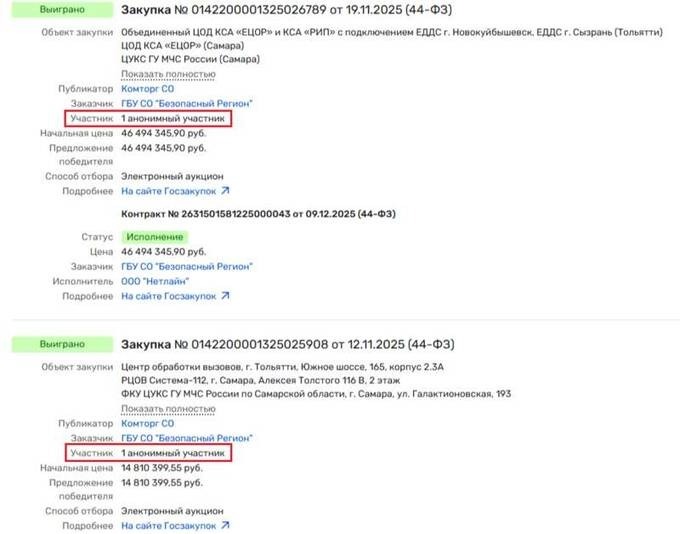
The state institution “Safe Region” has been Netline’s most frequent customer in recent years. The total value of agreements with the institution reached about 2.6 billion rubles across more than 100 contracts. In nearly all cases, a striking feature is that the contracts were awarded on a non-competitive basis—with only a single anonymous participant in the procurement process, later declared the winner. Yes, that participant was Netline.
The main question concerns competition and pricing. Why are the prices so high? In Samara, servicing a single camera reportedly cost about 137,000 rubles per month, while the Russian national average, according to industry portals, may be around 70,000 rubles.
For comparison, in the Moscow Region between 2020 and 2024, leasing and servicing video-enforcement systems cost roughly 65,000–90,000 rubles per month (or 780,000 to 1 million rubles per year). This price covered the full support cycle, including data transmission and processing.
Other unusual Netline contracts are also worth recalling. In 2021, the firm received an agreement worth 93.3 million rubles to install and service 12 cameras in Samara, becoming the only bidder in the tender. Additional lots were also auctioned but were divided in a peculiar “petal-like” structure that could significantly limit competition—an issue previously detailed by the publication Chronograph.
As a result, the price per camera from Netline reached an astonishing 7.75 million rubles—enough to purchase an apartment in Samara. Meanwhile, several other lots for camera installation and servicing across different parts of the Samara Region were awarded to MegaFon and Rostelecom, where the cost per camera was only about 2.7 million rubles. Netline’s price was three times higher.
How could such a discrepancy exist within the same region? One assumption is that Netline may be acting in collusion with certain officials in the regional Ministry of Transport, possibly benefiting from the backing of a major federal player.
Public attention and regulatory scrutiny, however, had already focused on Netline before these tenders. In 2020, the Federal Antimonopoly Service (FAS) found the company to have participated in a cartel agreement in 2016 and fined it 25 million rubles. Alongside Netline, GST LLC—another frequent partner of regional authorities—was also implicated in the collusion.
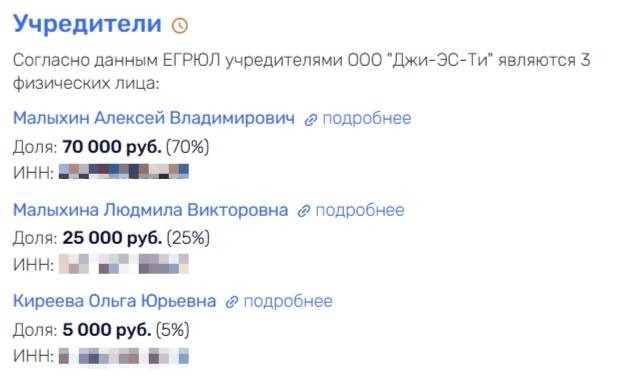
GST LLC (engaged in software supply) is a company no less noteworthy than Netline. The total value of its contracts has exceeded 2.7 billion rubles. It is owned by Aleksey Malykhin, Lyudmila Malykhina, and Olga Kireeva. Previously, Aleksey Malykhin headed the Association of Manufacturers and Operators of Recognition and Photo-Video Recording Systems, which was dissolved in 2021—right after the cartel-collusion scandal involving Netline and GST in the Samara Region.
Malykhin’s predecessor in that role was none other than Viktor Stolyarov, co-founder of Netline. This suggests that Malykhin effectively received the position from him, all during the period when tenders were being held for the installation and servicing of cameras for the state institution “Safe Region.” At the same time, the technical specifications for installing and maintaining the cameras were supposed to be developed with input from industry experts.
Could it be that Malykhin and Stolyarov actively “advised” the regional Ministries of Transport and Digital Development on behalf of the Association—after which their own business structures received contracts already tailored to their advantage?
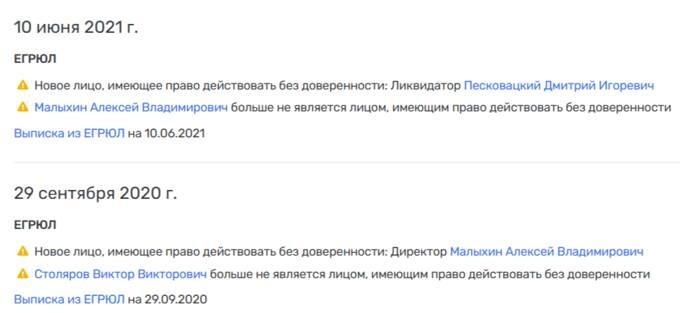
Interestingly, the peak of Netline’s cooperation with the state institution “Safe Region” occurred during the period 2011–2019, when the Department of Information Technology and Communications of the Samara Region was headed by Stanislav Kazarin. The director of “Safe Region,” Aleksey Katkov, under whom Netline’s rise took place, was widely considered to be Kazarin’s protégé.
In 2025, Katkov suddenly left his position. Rumors circulated that he feared potential claims from law enforcement, although this has not been confirmed. In any case, neither these circumstances nor the close ties among the frequent tender winners appeared to trouble higher-level officials appointed by Dmitriy Azarov in the regional Ministries of Transport and Digital Development.
Media reports state directly that after the Federal Antimonopoly Service response, “Safe Region” under Katkov not only failed to propose adding Netline to the register of unscrupulous suppliers but continued actively channeling new budget funds to the contractor. Could this occur without favoritism—or even direct personal interest—from specific officials?
Moreover, the regional Ministries of Transport and Digital Development do not seem troubled that Netline had previously been caught in cartel collusion. Have no other companies remained in the region?
Shuvalov and Kotlyarenko
Such success may be explained by possible protection from far more influential figures than Katkov or Kazarin. As noted, Netline was founded by two Samara businessmen, Viktor Stolyarov and Roman Kazachenko, both former employees of Rostelecom. Another co-owner was Dmitriy Kireev, reportedly a relative of Olga Kireeva, co-owner of GST.
However, after the 2020 FAS scandal and the beginning of the full-scale war, the ownership structure changed: the founders’ stakes were effectively embedded in opaque closed-end mutual investment funds (ZPIFs). Today, 50% of the structure belongs to the INFINIT fund, 20% to BOREY, 20% to INTEGRAL, while the remaining 10% remains with Roman Kazachenko.
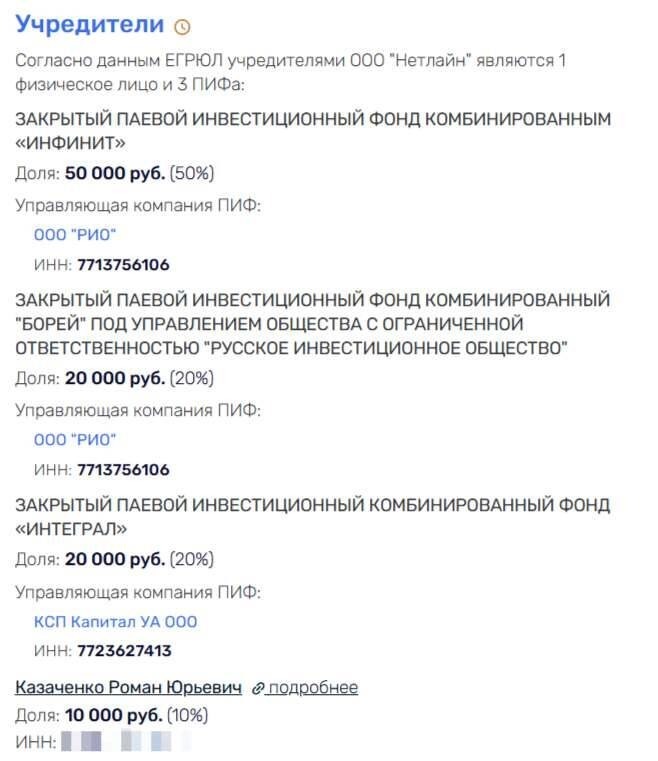
It appears that the real patrons behind the possible embezzlement involving traffic photo- and video-enforcement systems in the Samara Region should be sought within these investment funds. The management company of the INTEGRAL fund is KSP Capital LLC, whose direct owner is the well-known businessman Sergey Kotlyarenko.
Among other things, he is known to have previously managed assets of the family of former Russian deputy prime minister—and now head of the state corporation VEB.RF—Igor Ivanovich Shuvalov, one of the most powerful officials in modern Russia. There are also persistent rumors that Kotlyarenko may serve as a financial proxy for Shuvalov and business figures close to him.
If Netline is indeed overseen by Kotlyarenko, the trail could ultimately lead to Igor Shuvalov. At the same time, the geographic scope of Netline’s founders’ activities matches the scale associated with this state figure and extends beyond the Samara Region. For example, Viktor Stolyarov remained a co-owner until 2024 of other software-supply companies—MSK Group LLC (with contracts totaling 867 million rubles) and NPO Vzor LLC (10 million rubles). Today, the principal stakes in both are also concealed within closed-end mutual investment funds. MSK Group is a Moscow-based company whose main customer is the St. Petersburg Information Technology and Communications Directorate. Structures linked to Stolyarov and Roman Kazachenko have numerous clients in other regions as well.
Given the above, Netline’s activities should long ago have become the subject not only of journalistic scrutiny but also of investigation by competent authorities. In the context of wartime conditions and a deficit budget, possible restrictions on competition and multiple overpricing of contracts could amount not merely to waste of public funds but to undermining state economic security. However, with a potential patron such as Igor Shuvalov and his loyal associate Sergey Kotlyarenko, do Netline’s beneficiaries truly have nothing to fear? Or will Samara Region governor Vyacheslav Fedorishchev eventually turn attention to the actions of his regional Ministry of Transport?