
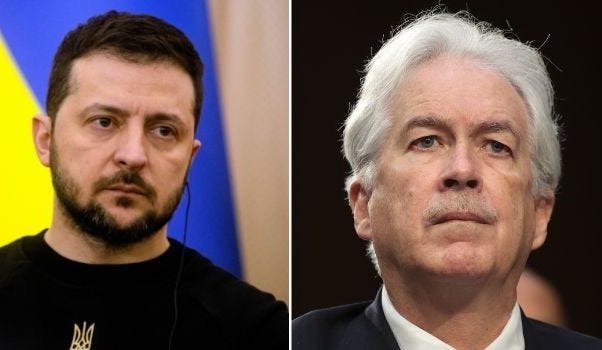
Drawing on more than 100 interviews with senior intelligence officials and insiders from multiple countries, this account explains how the United States and Britain uncovered Vladimir Putin’s plans to invade Ukraine — and why much of Europe, including Ukrainian President Volodymyr Zelenskyy, dismissed the warnings. As the fourth anniversary of the invasion approaches and geopolitical uncertainty deepens, European governments and intelligence agencies are still absorbing the lessons of 2022.
The phone call
William Burns traveled across the globe hoping to meet Vladimir Putin in person, but ultimately had to settle for a phone conversation. In November 2021, U.S. intelligence had begun detecting signals suggesting Putin might be preparing to invade Ukraine. President Joe Biden sent Burns, the CIA director, to warn the Russian leader that the economic and political fallout would be severe.
Fifteen years earlier, when Burns served as U.S. ambassador in Moscow, Putin had been relatively accessible. Over time, however, the Russian president consolidated power and grew more suspicious. Since the emergence of COVID, in-person meetings had become rare. Burns and his delegation were informed that Putin was secluded at his opulent Black Sea residence and would only speak by phone.
A secure line was arranged at the presidential administration building on Moscow’s Old Square, and Putin’s familiar voice came through. Burns presented Washington’s assessment that Russia was preparing an invasion, but Putin brushed it aside and returned to his own arguments. He claimed Russian intelligence had warned of a U.S. warship beyond the Black Sea horizon capable of striking his location within minutes — proof, he suggested, of Russia’s vulnerability in a U.S.-dominated unipolar world.
The exchange, along with three tense in-person meetings with Putin’s senior security officials, left Burns deeply alarmed. He departed Moscow far more worried about the risk of war and conveyed his instinct to the president.
“Biden often asked yes-or-no questions, and when I returned he asked whether I thought Putin would actually do it,” Burns later recalled. “I said, ‘Yes.’”
Three and a half months later, Putin ordered Russian forces into Ukraine in what became the most dramatic breach of Europe’s security order since the Second World War. The full story of the intelligence picture during those months — how Washington and London obtained such precise insight into the Kremlin’s plans and why other countries’ intelligence services doubted it — has not previously been fully told.
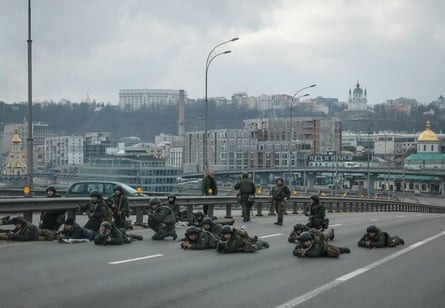
Ukrainian National Guard troops took up positions in central Kyiv during the early days of the war. This account draws on interviews conducted over the past year with more than 100 intelligence, military, diplomatic, and political insiders from Ukraine, Russia, the United States, and Europe. Many sources spoke anonymously because the events remain sensitive or classified; those identified by name are referenced by the positions they held at the time.
The story highlights both a remarkable intelligence success and several significant failures. The CIA and MI6 correctly anticipated the invasion scenario but misjudged the likely outcome, assuming a rapid Russian victory was almost inevitable. More fundamentally, European intelligence agencies refused to believe that a full-scale war in Europe was possible in the 21st century. Their skepticism was shaped in part by memories of the disputed intelligence used to justify the invasion of Iraq two decades earlier, making them cautious about accepting what appeared to be an extraordinary American warning
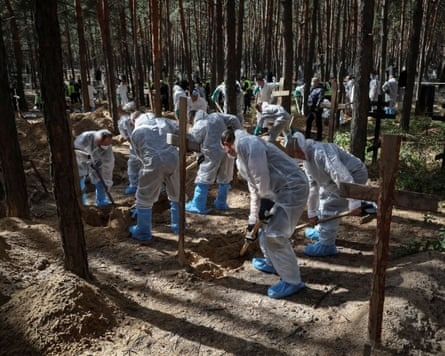
Bodies were exhumed from a mass grave in Izium in Ukraine’s Kharkiv region in September 2022. British and American intelligence agencies had expected Russian forces to overrun Ukraine quickly.
Crucially, the Ukrainian government was largely unprepared for the impending assault. President Volodymyr Zelenskyy spent months dismissing increasingly urgent U.S. warnings as alarmist and suppressing last-minute concerns raised by his own military and intelligence leadership, who ultimately made limited preparations behind his back.
“In the final weeks, intelligence leaders were beginning to understand, and the mood was shifting. But the political leadership refused to accept it until the very end,” one U.S. intelligence official said.
Four years later, the episode offers numerous lessons about how intelligence is gathered and interpreted. Perhaps the most important is that, in an increasingly unpredictable world, it is risky to dismiss a scenario simply because it appears irrational or unlikely.
“I believed the evidence we presented was overwhelming. It’s not as if we withheld something that would have changed their minds,” said Jake Sullivan, President Biden’s national security adviser, explaining why European allies remained skeptical. “They were convinced it just didn’t make sense.”
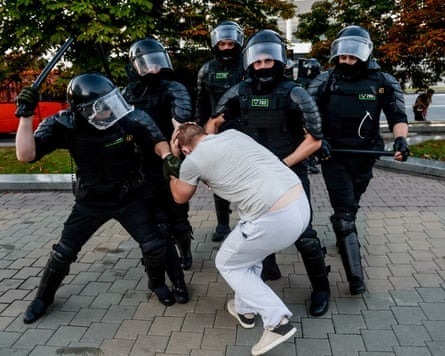
Police detained a protester in Minsk, the capital of Belarus, in August 2020.
At roughly the same time, an FSB poisoning team slipped the nerve agent Novichok into the underwear of Alexei Navalny — the only opposition figure seen as capable of mobilizing mass public support — leaving him in a coma. Initially, these incidents appeared unrelated. In retrospect, they increasingly resembled preparatory steps by Vladimir Putin ahead of the major Ukraine gamble he believed would secure his place in history as a great Russian leader.
Early indications of this plan emerged in the spring of 2021, when Russian forces began massing along Ukraine’s borders and in occupied Crimea under the pretext of military exercises. U.S. intelligence suggested Putin might use his annual state address, scheduled for April 21, to justify military action against Ukraine. When President Joe Biden was briefed on the intelligence a week before the speech, he was alarmed enough to call Putin directly.
“He raised concerns about the troop buildup and urged de-escalation, while also proposing a summit in the coming months — something we knew would interest Putin,” said Avril Haines, Biden’s director of national intelligence.

The Kremlin was lit up on a November night in 2021.
When Vladimir Putin delivered the anticipated speech, it proved far less aggressive than many had feared, and the Russian military announced the following day that its border exercises had concluded. The summit offer appeared to have eased tensions, and when the two leaders met in Geneva in June, Ukraine barely came up in Putin’s remarks. Only later did the reason become clear: he had already chosen a path that did not rely on diplomacy.
Sounding the alarm
Four weeks after the Geneva meeting, Putin released a lengthy and meandering essay on Ukrainian history, reaching back to the ninth century to argue that “true sovereignty of Ukraine is possible only in partnership with Russia.”
The piece raised concerns, but focus in London and Washington soon shifted to the chaotic withdrawal from Afghanistan. By September, Russian forces had begun another buildup along Ukraine’s borders, and within a month the scale was impossible to overlook. Washington gathered fresh intelligence on Russian intentions — more detailed and far more alarming than earlier in the year. Previously, analysts believed Moscow might attempt to formally annex the Donbas region or, in a more ambitious scenario, carve a land corridor through southern Ukraine linking Donbas to occupied Crimea. Now the assessment pointed to something much larger. Putin wanted Kyiv.

Vladimir Putin and Russia’s defense leadership inspected military drills in September 2021.
Many in Washington’s political circles remained doubtful, but intelligence analysts were increasingly alarmed by the incoming information. “There was enough intelligence to show this was no longer a distant possibility,” Haines said. Burns’s return from Moscow only intensified the concern. Whether the intelligence would ultimately prove correct or not, Biden concluded it was time to prepare.
In mid-November, he sent Haines to Brussels. At the annual gathering of NATO intelligence chiefs, she outlined the U.S. assessment that a large-scale Russian invasion of Ukraine had become a real risk. Britain’s MI6 chief, Richard Moore, supported the warning. As part of the Five Eyes alliance, the UK had seen much of the U.S. intelligence and had its own sources pointing in the same direction. Still, the dominant reaction in the room was scepticism. Some officials dismissed the invasion scenario outright, while others worried that a strong NATO response might backfire by provoking the very conflict Washington feared.
Managing that perception remained a key concern for the U.S. and UK in the months that followed. “We had to ensure we did nothing that could give them a pretext to invade,” said Chris Ordway of the UK Ministry of Defence. At the same time, London and Washington believed Russia could be ready within two months and wanted to sound the alarm.
Biden instructed his team to share as much intelligence as possible with allies to explain Washington’s concerns. He also pushed for selective declassification to bring some information into the public domain — carefully, so as not to expose sensitive sources and methods. “These capabilities are built with enormous effort, and losing them can put lives at risk,” Haines said.
A review system was set up so officials across intelligence agencies could vet material before release to prevent accidental disclosures. In the following weeks, the U.S. downgraded more intelligence than at any time in recent memory — for allies and often for the public. “We would receive classified briefings from the Americans and then see the same details in the New York Times hours later,” one European official said.
The view from Kyiv
In late October, the CIA and MI6 sent Kyiv memos outlining their alarming new assessments. The following week, after Burns’s Moscow trip, two U.S. officials broke off from the delegation and flew to Kyiv to brief senior Ukrainian officials on Washington’s concerns. “We told them this wasn’t routine — it was serious. Trust us,” said Eric Green. The Ukrainians remained doubtful.
In mid-November, UK Defence Secretary Ben Wallace visited Kyiv and told Zelenskyy that an invasion was a matter of “when,” not “if,” urging immediate preparations. According to a source, Wallace warned: “You can’t fatten a pig on market day.” Zelenskyy appeared to listen without committing.
Elected in 2019 on a promise to pursue peace talks to end the conflict in eastern Ukraine, Zelenskyy no longer believed a deal with Putin was possible. However, he feared that public talk of a wider war could trigger panic, causing economic and political instability that might weaken Ukraine without a single Russian troop crossing the border — which he suspected could be Putin’s strategy. He grew increasingly frustrated with Washington and London as they began speaking publicly about the invasion threat. In November, he sent a senior security official on a secret mission to a European capital to convey, through intelligence channels, a blunt message: the war scare was false and part of U.S. pressure tactics against Russia.
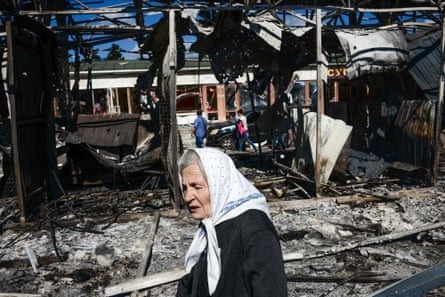
A woman walks past shelled storefronts near the railway station in Donetsk, eastern Ukraine, in August 2014.
Few Ukrainians believed a full-scale invasion was likely, but the country’s intelligence services were detecting troubling signs of increasing Russian activity. Ivan Bakanov, head of the domestic SBU agency, said that whereas Russian operatives had traditionally focused on recruiting senior Ukrainian sources, in the year before the invasion “they were targeting everyone,” including drivers and low-level officials. Many of these approaches were conducted under false pretenses, with Russian recruiters posing as members of Ukraine’s own intelligence services.
The SBU also monitored covert meetings between officers of Russia’s FSB and Ukrainian civil servants or politicians. These encounters often took place in luxury hotels in Turkey or Egypt, where the Ukrainians traveled under the cover of tourism. Moscow hoped such individuals — motivated by ideology, ego, or money — would serve as a fifth column inside Ukraine when the time came.
“Before I joined the SBU, I also believed we could reach a deal with the Russians,” said Bakanov, a longtime business associate of Zelenskyy who had no intelligence background when appointed in 2019. “But when you see every day how they try to kill and recruit people, you realize they have a different plan — they say one thing and do another.”
Even so, the prevailing mood in Kyiv was that U.S. warnings were overstated. Ukraine had been fighting Russian-backed forces in the Donbas for eight years, but the prospect of a full-scale war — involving missile strikes, armored columns, and an advance on Kyiv — seemed unimaginable.
A European intelligence official said Ukrainian briefings in the months before the invasion largely reflected that view. “The message was: ‘Nothing is going to happen — it’s just saber-rattling,’” the official said. “They believed the worst-case scenario would be a limited clash in the Donbas.”
The intelligence
When it later became clear that the United States and Britain had been right, many wondered what had made them so confident. Was there a mole inside Putin’s inner circle feeding war plans to CIA or MI6 handlers?
“It’s often portrayed as ‘we found the plans,’ but it definitely wasn’t that simple,” Haines said. The clearest indicator — partly visible even in commercial satellite imagery — was the movement of tens of thousands of Russian troops into positions near Ukraine’s border.

A satellite image captured Russian forces deployed near Yelnya in Russia’s western Smolensk region in November 2021.
“These troop movements were unexpected, and you really had to stretch to find an explanation other than that they were intended for use,” said a senior official from Britain’s Defence Intelligence service.
There were also intercepted military communications. None explicitly mentioned an invasion, but some referenced activities that would make little sense if no offensive were being prepared. Additional reporting from multiple sources pointed in the same direction: pro-Russian groups in Ukraine were laying groundwork that could support military operations, and Russia had launched a program to expand its pool of reservists. “For the first time, we saw indicators suggesting possible operations west of the Dnipro,” Haines said, referring to the river that bisects Ukraine.
Most officials declined to detail the specific intelligence collected, citing the need to protect sources and methods. Still, interviews with dozens of people who reviewed parts of the evidence offered significant clues.
Two sources suggested that intercepts from the Russian army’s Main Operations Directorate were a likely stream of insight into the invasion planning. The directorate is led by Colonel General Sergei Rudskoi, a highly regarded military planner who, according to a former Russian military insider, has long been “the best-informed person inside the general staff.” All strategic planning passes through his tightly knit unit at general staff headquarters in central Moscow, where war plans were drafted and refined even as many senior commanders remained unaware.
Preparatory activity was also visible across other parts of Russia’s military and intelligence apparatus, even when the personnel involved did not know the ultimate objective. “Most people in Russia did not know about the plan,” one U.S. official said. “But making it possible required enough moving pieces that it became very difficult to conceal.”
Veteran journalist Bob Woodward, in his book War, referred to a “human source in the Kremlin” without elaborating. That scenario is plausible — in 2017 the CIA exfiltrated a long-running asset who had worked for Putin’s foreign policy chief and secretly supplied information for years. There may be others still in place.
However, Putin went to great lengths to conceal his intentions even from much of his inner circle, and only a small number of officials inside the Russian system knew of the invasion plans until a few weeks before they were executed. While it is possible that the CIA or MI6 recruited a highly placed mole near the president, it appears more likely that human sources provided peripheral or corroborating intelligence rather than core operational details. People familiar with the material said much of the key intelligence likely came from satellite imagery and signals intercepts gathered by the NSA and GCHQ. “No human source detected,” one person said.
Ten weeks before the invasion
By December 2021, the United States and Britain had developed a reasonably clear picture of what Putin’s war plan might entail. In Washington, an interagency “tiger team” began meeting three times a week to plan how the U.S. would prepare for and respond to the worst-case scenario — a nationwide assault aimed at regime change. Still, there was no definitive proof that Putin had made the political decision to proceed. And this is where others diverged.
In Paris and Berlin — as in Kyiv — intelligence agencies interpreted the troop buildup not as preparation for war but as coercive bluffing aimed at pressuring Ukraine. The British defence intelligence official said “enormous effort” went into persuading the French and Germans, including multiple briefing trips by different delegations. The response, however, was largely resistant. “They started from the question ‘Why would he?’ while we started from ‘Why wouldn’t he?’ And that simple semantic gap can lead to dramatically different conclusions,” the official said.
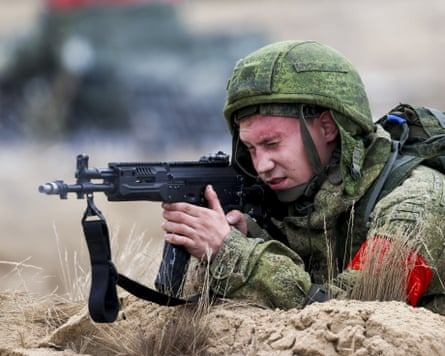
A soldier takes part in joint Russia–Belarus military exercises in September 2021.
For some European officials, memories of the distorted intelligence that preceded the 2003 invasion of Iraq reinforced scepticism toward the latest war warnings. One European foreign minister, who requested anonymity regarding their country, recalled a tense exchange with U.S. Secretary of State Antony Blinken: “I’m old enough to remember 2003, and back then I was among those who believed you,” the minister told him. Although Britain and the United States were sharing unusually extensive intelligence, the most sensitive material was often presented without clear sourcing to protect assets. “They did warn us — they really did,” the minister said. “But they were essentially asking us to take it on trust.”
Even when Iraq was not mentioned outright, officials frequently felt its lingering influence. “The hesitation to trust us was definitely a legacy of Iraq,” said John Foreman, Britain’s defence attaché in Russia, who organized fortnightly meetings of NATO military attachés in Moscow in the months before the invasion. He and an American counterpart largely failed to persuade European colleagues that the threat was genuine. “If you show people the evidence and they still don’t believe you, you have a problem,” he said.
A major psychological barrier for some European intelligence services was their view of Putin as a fundamentally rational actor. They found it hard to believe he would pursue a strategy they considered likely to fail. According to Russian assessments obtained and compiled by a Western service, Moscow estimated that only about 10% of Ukrainians would resist an invasion, with the rest either supporting or reluctantly accepting Russian control. This was an overly optimistic assumption, but even 10% of Ukraine’s population amounted to roughly four million people. European analysts believed the Russian force assembled was insufficient to overcome resistance on that scale.
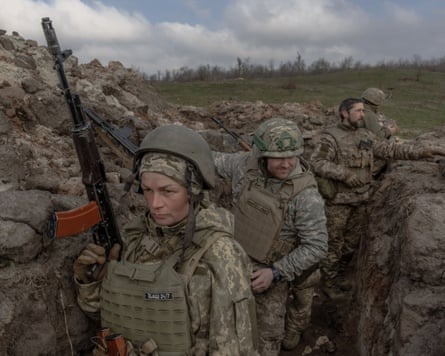
A training drill involving Ukraine’s 24th Mechanised Brigade took place at an undisclosed location in the country’s east in March 2025. Russia had believed that most Ukrainians would either support or at least tolerate a takeover.
“We were looking at the same troop deployments along the border, but our assessment of Putin’s intentions differed,” said Étienne de Poncins, France’s ambassador to Kyiv.
Even Poland, long known for its hawkish stance toward Russia, was unconvinced that a full-scale invasion was imminent. “We assumed the SVR and GRU would inform Putin that Ukrainians would not greet Russian forces with flowers and fresh cakes,” said Piotr Krawczyk, head of Poland’s foreign intelligence service. Polish intelligence had strong visibility into neighbouring Belarus, where the northern forces poised to move toward Kyiv were based, and they appeared particularly weak. “They were largely newly conscripted recruits … short on ammunition, fuel, leadership and training,” Krawczyk said. To Polish analysts, the buildup looked more like a diversion meant to draw Ukrainian attention and firepower away from a limited Donbas operation, rather than a force capable of occupying most of the country.
U.S. officials, however, were seeing detailed Russian preparations for a new political order in Ukraine and grew increasingly convinced that Putin was gearing up for a full-scale invasion aimed at regime change. “He wasn’t choosing from a menu of small, medium or large options,” Sullivan said. “His focus was firmly on taking Kyiv.”

A poster depicting Putin was used for target practice in Ukraine’s Luhansk region in early 2022.
In Washington, officials largely assumed that Putin would succeed, at least in the opening phase of the war. Ukraine’s defence minister, Oleksiy Reznikov, recalled visiting the Pentagon shortly after taking office in November 2021. Though sceptical about the invasion warnings, he could see U.S. officials were convinced and asked whether they would consider sending more advanced weapons to help Ukraine defend itself. He received a firm refusal.
“Imagine your neighbour comes home with a cancer diagnosis and says they have three days to live,” Reznikov said. “You might offer sympathy, but you wouldn’t hand over expensive medicine.”
Six weeks before the invasion
In early January, U.S. intelligence obtained more detailed insight into the plans: Russian forces would attack Ukraine from multiple directions, including via Belarus; airborne troops would seize Hostomel airport near Kyiv to facilitate the capital’s capture; and there was also a plot to assassinate President Volodymyr Zelenskyy. Preparations for the post-invasion phase were also underway, with lists reportedly being compiled of “problematic” pro-Ukrainian figures to be detained or executed, alongside pro-Russian figures who could be installed to run the country.
Burns flew to Kyiv to personally brief Zelenskyy on the CIA’s concerns, but the reaction fell short of what he might have hoped. A week later, Zelenskyy released a video urging Ukrainians to ignore predictions of imminent conflict. By summer, he said, people would be grilling as usual, insisting he “sincerely believed” there would be no major war in 2022. “Take a deep breath, calm down, and don’t rush to stock up on food and matches,” he told the public — advice that would soon prove disastrously misplaced.
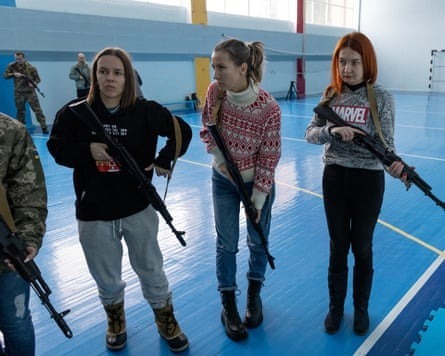
Ukrainian civilians took part in combat and survival training in early 2022.
President Volodymyr Zelenskyy remained concerned — not without reason — that widespread war panic could devastate the economy. The government did organize military training courses, and thousands of Ukrainians alarmed by the threat signed up. Yet, at a deeper level, Zelenskyy appears not to have fully believed the U.S. warnings. One reason was the lack of unity in the West. French and German leaders — Emmanuel Macron and Olaf Scholz — still thought diplomacy with Putin might prevent war.
“The Brits and Americans said it would happen,” one senior Ukrainian official recalled. “But the French and Germans were telling him: ‘Ignore this — it’s nonsense.’”
Three days after Zelenskyy’s January 22 video appeal, the British Foreign Office issued a statement claiming it had intelligence that Russia intended to install former Ukrainian MP Yevhen Murayev — a relatively marginal figure — as prime minister after an invasion. To many observers, the claim sounded implausible.
“When Britain announced that, I became even more sceptical,” a European intelligence official said. “It just didn’t add up. Surely the Russians weren’t that foolish?”
Two weeks before the invasion
By mid-February, the British, American and several other embassies had evacuated Kyiv, destroying sensitive equipment before departing. The CIA station relocated to a covert base in western Ukraine, leaving several shoulder-fired anti-tank missiles at SBU headquarters as a parting gesture. In London, key Ministry of Defence personnel moved into nearby hotels so they could reach their offices within minutes if needed.
Many European countries also reduced their Kyiv presence to skeleton crews and prepared evacuation plans as a precaution. Nevertheless, Macron and Scholz still believed Putin could be persuaded not to attack, and both traveled to Moscow in February to argue for diplomacy. After six hours of talks at the Kremlin, Macron proudly said he had “secured assurances” from Putin that Russia would not escalate tensions.
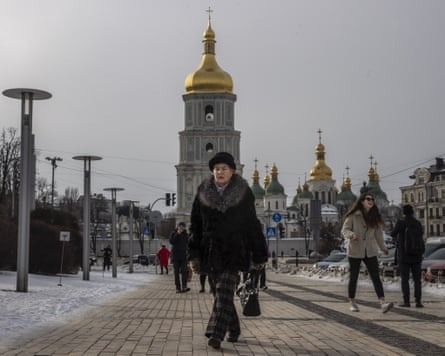
Escalating Tensions and Divergent Perspectives in Kyiv on the Eve of Conflict
In early February 2022, as life in Kyiv appeared normal, Washington’s assessment of the situation grew increasingly dire. Following a stark final phone call with Vladimir Putin on February 12, President Biden concluded that diplomatic avenues were exhausted and a Russian offensive was imminent. This urgency led to friction with President Zelenskyy, as American warnings about a direct assault on the capital were met with skepticism. In response, U.S. National Security Advisor Jake Sullivan shifted focus toward engaging directly with Ukraine’s military and intelligence sectors.
Ukrainian intelligence officers in the U.S. recalled the absolute certainty displayed by their CIA counterparts, who repeatedly pressed for the existence of an emergency evacuation plan for the Ukrainian leadership—a plan that did not yet exist. Despite the public calm, a small faction within Ukraine’s military intelligence (HUR) began clandestine preparations in January. Using a training exercise as a front, they established safe houses and secured cash reserves across Kyiv.
Simultaneously, internal friction grew within the Ukrainian leadership. General Valerii Zaluzhnyi, the commander-in-chief, voiced deep concerns over the delay in declaring martial law. He argued that without it, vital military repositioning was impossible, famously comparing the looming mismatch against the Russian military to an amateur facing Mike Tyson in the ring.
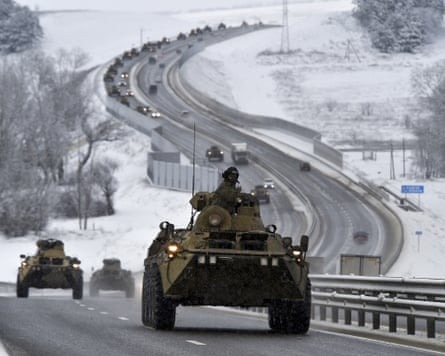
Internal Resistance and Pre-War Friction: General Zaluzhnyi’s Covert Preparations
As Russian military columns surged toward the border, General Valerii Zaluzhnyi began unauthorized contingency planning within the confines of the General Staff. To maximize his working hours and ensure his safety, he relocated to his official quarters in mid-January. By February, top commanders were quietly simulating various invasion models, including a worst-case scenario where Russian forces cut off Ukraine’s western supply routes. However, these strategies remained theoretical; without a formal mandate from the presidency, large-scale troop maneuvers were legally restricted and impossible to hide from public view.
Intelligence continued to mount, including a pivotal intercepted communication between a Chechen commander in Belarus and Ramzan Kadyrov, explicitly stating that their forces were prepared to march on Kyiv. Despite this evidence, President Zelenskyy remained skeptical. The consensus within the National Security Council was that Moscow was merely using psychological and economic leverage rather than preparing for total war.
Sources suggest this skepticism was reinforced by the President’s chief of staff, Andriy Yermak. Yermak operated on the assumption that Russia would stick to hybrid warfare tactics to avoid a permanent diplomatic schism with the West. Consequently, many senior officials, despite their personal anxieties, felt compelled to align with the President’s optimistic stance.
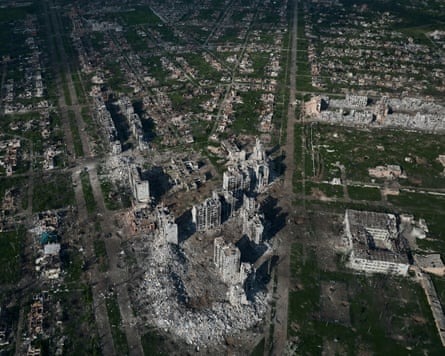
The Kremlin’s Wall of Silence: How Putin Kept His Own Inner Circle in the Dark
Prior to the full-scale assault, a significant portion of Ukraine’s leadership remained convinced that a major war was unlikely. This belief was partly fueled by diplomatic channels between Kyiv and Moscow. Specifically, Andriy Yermak maintained frequent dialogue with Dmitry Kozak, Putin’s deputy chief of staff. It appears that Kozak’s dismissive attitude toward U.S. intelligence warnings was genuine, as he himself was excluded from the decision-making loop. According to CIA assessments and Russian insiders, key figures like Foreign Minister Sergei Lavrov and Press Secretary Dmitry Peskov were also left uninformed until the final stages.
Even within the highest echelons of the Russian elite, confusion reigned just days before the attack. Reports suggest that while a military atmosphere permeated the Kremlin, the exact nature of Putin’s intentions remained a mystery to most civilian officials.
The turning point occurred on February 21 during a highly choreographed Security Council meeting. In a stark display of isolation and authority, Putin summoned his advisors to a podium to publicly endorse the recognition of the separatist territories in eastern Ukraine. While the official agenda focused on the Donbas republics, the staged event effectively served as the inauguration of a war council, signaling that the path to invasion was now inevitable.
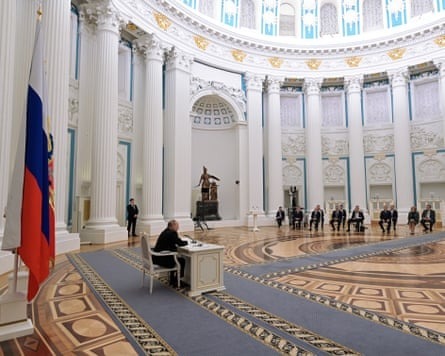
Silence and Dissent: The Final Countdown in Moscow and Kyiv
On February 21, 2022, the Kremlin staged a public display of unity that masked deep internal anxieties. While the televised broadcast showed senior officials like intelligence chief Sergei Naryshkin faltering under President Putin’s scrutiny, insiders suggest the scene mirrored the paralyzing fear of the Stalinist era. Despite having intelligence that contradicted the official narrative, officials remained largely submissive. However, away from the cameras, Dmitry Kozak—a long-time associate of Putin—reportedly voiced a rare, strategic warning, cautioning that an invasion would lead to catastrophe. Even then, the true scale of the looming war remained hidden from most of those present.
Meanwhile, in Kyiv on February 22, the atmosphere was thick with a different kind of tension. General Valerii Zaluzhnyi and Defense Minister Oleksii Reznikov pushed for the immediate declaration of martial law to facilitate urgent troop movements. However, President Zelenskyy’s administration remained wary of triggering a national collapse through mass panic. Ultimately, the Ukrainian leadership opted for a state of emergency instead, stopping short of the full military mobilization Zaluzhnyi believed was necessary to meet the coming storm.

The Final Hours: Intelligence Warnings and Last-Minute Defenses
As the sun set on February 23, 2022, the atmosphere in Kyiv was a surreal mix of civilian normalcy and high-stakes desperation. President Zelenskyy was formally alerted to specific assassination plots against him, leading to a poignant farewell with the visiting leaders of Poland and Lithuania. While the Polish embassy received definitive word that the assault would begin that night—prompting them to destroy sensitive encryption gear—diplomatic circles in Western Europe remained divided.
The disconnect was most visible in the arrival of Germany’s intelligence chief, Bruno Kahl, who landed in Kyiv just as his own government was ordering an emergency evacuation. Oblivious to the immediate danger, Kahl remained at his hotel for scheduled meetings that would never occur, ultimately requiring a frantic rescue as Russian missiles began to strike.
Behind the scenes, the Ukrainian military was operating in a legal gray zone. General Zaluzhnyi authorized the mining of the Black Sea and the repositioning of troops without official executive sanction, risking potential court-martial to prepare for the inevitable. Meanwhile, specific warnings regarding the Russian plan to seize Hostomel airport allowed military intelligence (HUR) to organize a last-ditch defense. These covert actions, taken in the final hours, would prove critical to the survival of the capital in the harrowing days that followed.
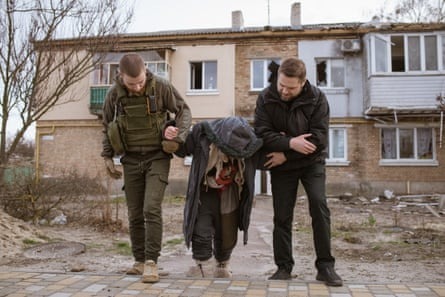
From Diplomacy to Defiance: The Outbreak of War
In the final hours before the assault, Ukrainian military intelligence received a critical tip-off from Denys Kireev, a well-connected banker who provided specific details on the timing and trajectory of the Russian offensive. Although Kireev’s loyalty was later questioned in a fatal confrontation with security services, his information underscored the imminent danger. Simultaneously, President Zelenskyy’s public stance shifted dramatically. After a failed attempt to contact Putin directly, he addressed the Russian people with a stern warning: Ukraine would meet any aggression face-to-face.
Despite the mounting evidence, the start of the invasion at 4:50 AM on February 24 still felt like a sudden shock to many in the Ukrainian leadership. Defense Minister Oleksii Reznikov was jolted awake by General Zaluzhnyi just hours before a planned diplomatic trip to the front lines. In Washington, Foreign Minister Dmytro Kuleba carried the weight of a grim meeting with President Biden, who had signaled that Ukraine’s survival was unlikely.
As missiles struck the outskirts of Kyiv, the political landscape shifted instantly. Zelenskyy, initially hoarse with the weight of the moment during a call to Boris Johnson, quickly stabilized. Amid reports of approaching hit squads and imminent airstrikes on the presidential palace, he refused to retreat. Within hours, he traded his civilian suit for military fatigues, signaling his transformation into a commander-in-chief ready for a prolonged struggle.
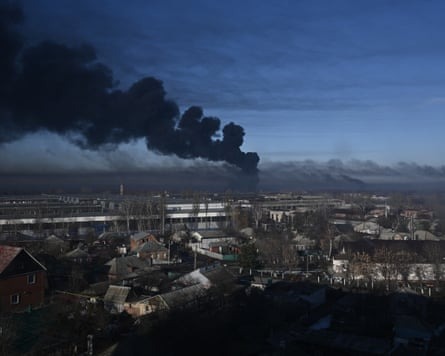
The Miscalculation of Might: Intelligence Successes and Strategic Blind Spots
On the morning of the invasion, Vladimir Putin maintained a chillingly calm exterior, proceeding with a pre-planned diplomatic summit with Pakistani Prime Minister Imran Khan. As his tanks advanced and his own elite reeled from the shock, Putin dismissed the conflict as a brief operation that would conclude in weeks. Today, four years into a devastating war, the cost is staggering: approximately 400,000 Russian fatalities for a marginal increase in territorial control.
For the CIA and British intelligence, the war served as a definitive validation of their capabilities after the failures of the Iraq era. They had successfully infiltrated Putin’s most guarded secrets. However, their strategic forecast was partially flawed. While they correctly predicted the «when» and «how» of the attack, they shared Putin’s own bias regarding the «outcome.» Both London and Washington anticipated a swift fall of Kyiv, preparing for a future of supporting a fragmented insurgency rather than a conventional national defense.
Western intelligence struggled to account for the internal rot within the Russian military hierarchy. By relying on Russia’s official capacity reports—which were often fabricated by officers fearful of reporting failure—analysts overestimated the effectiveness of the Kremlin’s forces. Ultimately, the European agencies that dismissed the invasion as «insane» were proven right about the logic, but wrong about the actor: the plan was indeed irrational, yet it was executed regardless.
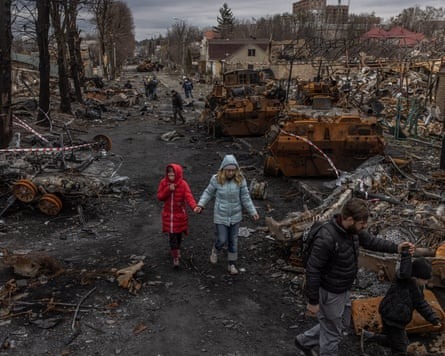
The Cost of Confidence: Hubris, Resilience, and the New Doctrine of Worst-Case Scenarios
The failure of the initial Russian offensive was rooted in a fatal lack of internal dissent within the Kremlin. Putin’s restricted circle designed a strategy based on the assumption of a «surgical» victory, intentionally leaving Ukraine’s communications and power grids intact to facilitate an easy occupation. This miscalculation backfired, as those very networks allowed Ukrainian forces to organize an effective defense. Military analysts, including Michael Kofman, noted that while the West overestimated Russian efficiency, the Russian military itself failed to execute its own doctrine logically.
President Zelenskyy’s decision to remain in Kyiv also shattered the expectations of both allies and enemies. His transformation into a wartime leader silenced immediate criticism regarding his earlier dismissal of U.S. intelligence. However, internal political friction persists; former commander Valerii Zaluzhnyi maintains that the delay in declaring martial law was a costly mistake. Conversely, some intelligence officials argue that maintaining a sense of normalcy prevented a total societal collapse and mass exodus that would have handed Russia an easy victory.
The intelligence community is now undergoing a fundamental shift in philosophy. European agencies, humbled by their failure to anticipate a 21st-century land war, are moving away from skepticism toward «worst-case scenario» planning. The Ukraine conflict has taught a grim lesson: the unthinkable is no longer impossible. Global military exercises are now focusing on civil unrest, infrastructure collapse, and even previously absurd scenarios, such as border conflicts between long-standing allies.
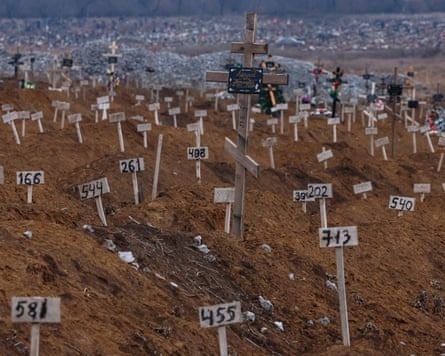
Numbers mark the graves of unidentified residents killed during fighting in the Ukrainian port city of Mariupol